

FreeRTOS Memory Pool: Zero-Copy Data Transfer
September 25, 2026
7 min
Rate Monotonic Scheduling (RMS) assigns static priorities based on period — shorter period, higher priority. It’s optimal among fixed-priority schemes, but it has a structural weakness: priority inversion. A high-priority task blocks on a mutex held by a low-priority task, and a medium-priority task preempts the low-priority holder, indefinitely delaying the high-priority task.
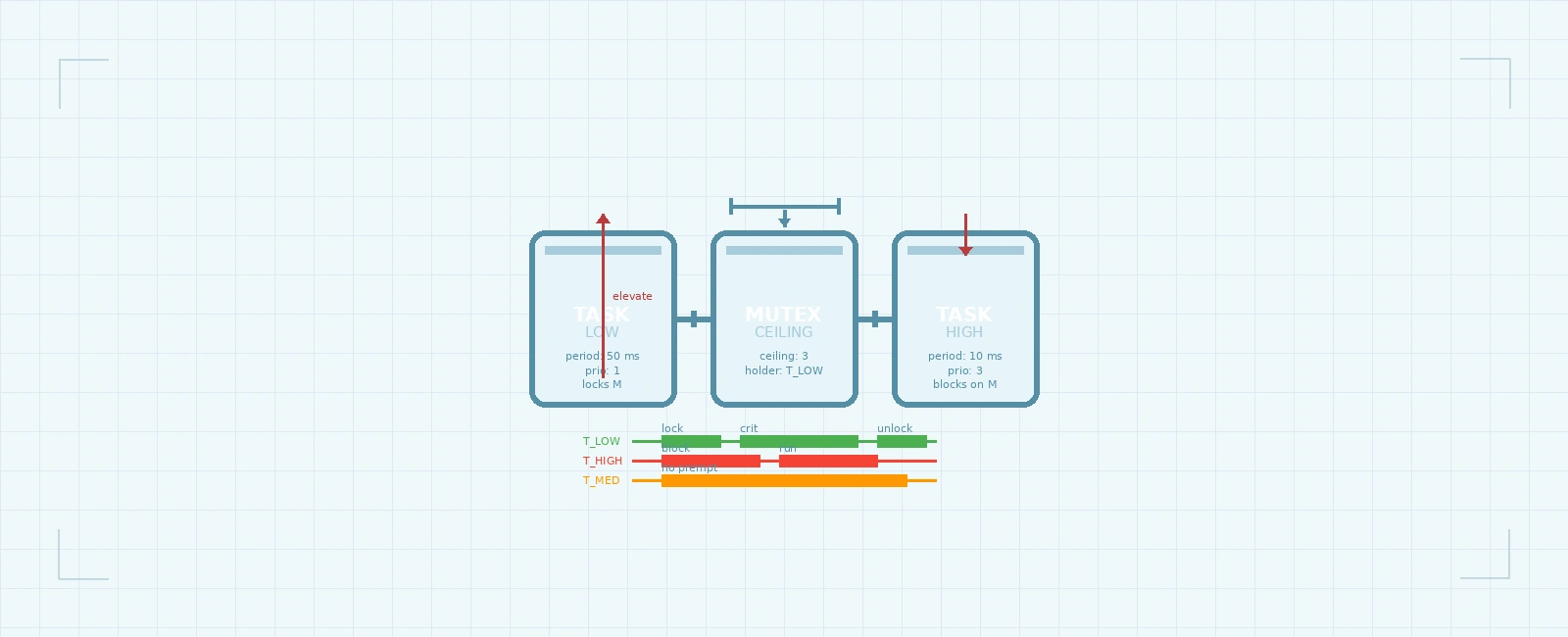
The Priority Ceiling Protocol (PCP) eliminates this by assigning each mutex a ceiling priority equal to the highest priority of any task that may lock it. When a task locks the mutex, its effective priority is immediately elevated to the ceiling. No medium-priority task can preempt it. The high-priority task waits at most one critical section — the blocking is bounded and non-transitive.
This article shows how PCP works, how to implement it in FreeRTOS, and how to verify the blocking bound in response-time analysis.
Consider three tasks under RMS:
+--------+--------+-----------+--------------------------+| Task | Period | Priority | Critical Section (mutex) |+--------+--------+-----------+--------------------------+| T_High | 10 ms | 3 (High) | Locks M for 1 ms || T_Med | 20 ms | 2 (Med) | No mutex || T_Low | 50 ms | 1 (Low) | Locks M for 4 ms |+--------+--------+-----------+--------------------------+
Timeline without PCP:
Time ->T_Low : [Lock M] [Unlock]T_High: [Blocked] [Blocked] [Runs...]T_Med : [Preempt]
T_High suffers unbounded blocking — it waits for T_Low and T_Med. The medium-priority task indirectly blocks the high-priority task.
Note on variants: There are two main flavors of PCP. The Original Priority Ceiling Protocol (OPCP) elevates priority only when a higher-priority task blocks on the resource. The Immediate Priority Ceiling Protocol (IPCP) (also known as Priority Ceiling Emulation or OSEK PCP) elevates the priority immediately upon locking. IPCP is structurally simpler, avoids unnecessary context switches, and is the standard in AUTOSAR, POSIX (PTHREAD_PRIO_PROTECT), and most RTOS implementations. This article focuses on IPCP.
Each mutex M gets a ceiling priority C(M):
C(M) = max{ priority(T) | T may lock M }
In the example above: C(M) = priority(T_High) = 3.
When T_Low locks M, its effective priority becomes 3. T_Med (priority 2) cannot preempt. T_Low runs to completion of its critical section at priority 3, then unlocks and drops back to priority 1.
Time ->T_Low : [== Lock M (4ms) ==] <-- runs at ceiling prio 3T_High: [BLOCKED] [RUNS after unlock...]T_Med : [NO PREEMPT]
Key properties:
FreeRTOS does not implement PCP natively. It provides Priority Inheritance (PIP) via configUSE_MUTEXES + xSemaphoreCreateMutex(). For PCP, you must implement the ceiling logic manually or use a wrapper.
#include "FreeRTOS.h"#include "semphr.h"#include "task.h"typedef struct {SemaphoreHandle_t mutex;UBaseType_t ceiling_priority; // PCP ceilingUBaseType_t holder_priority; // Priority before this lock's elevationTaskHandle_t holder; // Current holder} CeilingMutex_t;/* Create a ceiling mutex with explicit ceiling priority */CeilingMutex_t *CeilingMutex_Create(UBaseType_t ceiling_prio) {CeilingMutex_t *cm = pvPortMalloc(sizeof(CeilingMutex_t));if (!cm) return NULL;cm->mutex = xSemaphoreCreateMutex();if (!cm->mutex) {vPortFree(cm);return NULL;}cm->ceiling_priority = ceiling_prio;cm->holder = NULL;cm->holder_priority = 0;return cm;}/* Lock with immediate priority ceiling elevation */BaseType_t CeilingMutex_Lock(CeilingMutex_t *cm, TickType_t timeout) {TaskHandle_t me = xTaskGetCurrentTaskHandle();UBaseType_t original_prio = uxTaskPriorityGet(me);/* Elevate priority BEFORE locking to prevent preemption by amedium-priority task immediately after acquiring the lock. */if (cm->ceiling_priority > original_prio) {vTaskPrioritySet(me, cm->ceiling_priority);}if (xSemaphoreTake(cm->mutex, timeout) == pdTRUE) {cm->holder = me;cm->holder_priority = original_prio;return pdTRUE;}/* Lock failed (timeout), restore priority */if (cm->ceiling_priority > original_prio) {vTaskPrioritySet(me, original_prio);}return pdFALSE;}/* Unlock and restore original priority */void CeilingMutex_Unlock(CeilingMutex_t *cm) {if (cm->holder == xTaskGetCurrentTaskHandle()) {UBaseType_t prio_to_restore = cm->holder_priority;/* Restore priority only if this mutex actually caused the current elevation.This correctly handles nested locks assuming LIFO unlock order. */BaseType_t needs_restore = (cm->ceiling_priority > prio_to_restore) &&(uxTaskPriorityGet(NULL) == cm->ceiling_priority);cm->holder = NULL;cm->holder_priority = 0;/* Give the mutex BEFORE dropping priority to prevent medium-prioritytasks from preempting and causing priority inversion. */xSemaphoreGive(cm->mutex);if (needs_restore) {vTaskPrioritySet(NULL, prio_to_restore);}}}/* Delete and free */void CeilingMutex_Delete(CeilingMutex_t *cm) {vSemaphoreDelete(cm->mutex);vPortFree(cm);}
/* Mutex ceiling = highest priority of any task using it (Priority 3) */static CeilingMutex_t *spi_mutex = NULL;void SystemInit(void) {spi_mutex = CeilingMutex_Create(3); /* Ceiling = Priority 3 (T_High) */}void Task_High(void *pv) {for (;;) {if (CeilingMutex_Lock(spi_mutex, pdMS_TO_TICKS(100))) {/* Critical section: SPI transaction */SPI_Transaction();CeilingMutex_Unlock(spi_mutex);}vTaskDelay(pdMS_TO_TICKS(10));}}void Task_Low(void *pv) {for (;;) {if (CeilingMutex_Lock(spi_mutex, pdMS_TO_TICKS(100))) {/* Long critical section: 4ms SPI DMA setup */SPI_DMA_Setup();CeilingMutex_Unlock(spi_mutex);}vTaskDelay(pdMS_TO_TICKS(50));}}
The classic response-time equation for task τ_i under RMS:
R_i = C_i + B_i + Σ_{j ∈ hp(i)} ⌈R_i / T_j⌉ × C_j
Where:
C_i = WCET of task τ_iB_i = Blocking time from lower-priority taskshp(i) = set of higher-priority tasksB_i with PCPUnder PCP, task τ_i can be blocked at most once by a lower-priority task holding a resource whose ceiling is ≥ priority of τ_i:
B_i = max{ C_k^crit | priority(k) < priority(i) AND ceiling(M) ≥ priority(i) }
Where C_k^crit is the WCET of the critical section of task τ_k on mutex M.
Example calculation:
| Task | Period | Priority | WCET | Critical Section (M) |
|---|---|---|---|---|
| T_H | 10 ms | 3 | 2 ms | 1 ms |
| T_M | 20 ms | 2 | 3 ms | — |
| T_L | 50 ms | 1 | 5 ms | 4 ms |
Ceiling(M) = 3 (from T_H)
A common misconception is that T_H cannot be blocked by T_L because T_H has a higher priority. However, under PCP, if T_L acquires M before T_H is released, T_L’s priority is immediately elevated to the ceiling (3). When T_H arrives, it cannot preempt T_L. Thus, T_H is blocked by T_L’s critical section (4 ms). The key is: T_H is blocked only by T_L’s critical section, and T_M cannot intervene and cause transitive blocking.
Response times:
All tasks schedulable.
+--------------------------------------------------+| PRIORITY CEILING PROTOCOL || STATE MACHINE |+--------------------------------------------------+TASK STATE MUTEX STATE+---------+ +-------------+| READY | | UNLOCKED || | | | ceiling = 3 || v | +-------------+| RUNNING | || | | | lock(M)| |lock | v| v | +-------------+| BLOCKED |<--------------->| LOCKED || | | | holder=T_Low|| |unlk | | prio=3(ceil)|| v | +-------------+| READY | |+---------+ | unlock(M)^ v| +-------------++----------------------| UNLOCKED |+-------------+PREEMPTION BEHAVIOR WITH PCPTime ->+--------------------------------------------------+| T_Low : [=== LOCK M ===] [UNLOCK] [=========] || | | || (eff_prio=3) | || v v || T_High: --- BLOCKED ---> RUNNING -----------> || ^ ^ || T_Med : - NO PREEMPT - NO PREEMPT - NO PREEMPT- |+--------------------------------------------------+
| Criterion | Priority Ceiling (PCP) | Priority Inheritance (PIP) |
|---|---|---|
| Blocking bound | Single critical section (max) | Multiple critical sections (chained) |
| Chained blocking | Impossible | Possible (transitive) |
| Deadlock freedom | Guaranteed | Not guaranteed |
| Implementation complexity | Higher (static ceilings) | Lower (dynamic) |
| Runtime overhead | One priority change per lock | Multiple priority changes |
| RTOS support | Manual / AUTOSAR / ARINC 653 | FreeRTOS (native), Zephyr, QNX |
| Best for | Safety-critical, certifiable | General-purpose, dynamic workloads |
Ceiling assignment: Compute ceilings offline during system configuration. The ceiling is the maximum priority of any task that may lock the mutex — not just tasks that currently do.
Interrupt safety: FreeRTOS mutexes cannot be used in ISRs, and priority elevation is meaningless for interrupts. Never call CeilingMutex_Lock from an ISR; use lock-free ring buffers or FromISR synchronization primitives instead.
Nested critical sections: PCP handles nested locks correctly if ceilings are computed transitively. The effective priority becomes the maximum of all held mutex ceilings.
Base Priority Tracking: When manipulating task priorities manually, avoid mixing FreeRTOS’s native Priority Inheritance (PIP) with IPCP on the same task. Doing so can cause FreeRTOS to lose track of the task’s true base priority.
Verification: Use response-time analysis with the B_i blocking term. Tools like Rapita RapiTime, LDRA, or Mast can automate this.
Priority inversion is not a theoretical curiosity — it caused the Mars Pathfinder reset in 1997. Rate Monotonic Scheduling guarantees optimal fixed-priority assignment, but without a resource protocol, the scheduling guarantees collapse under resource sharing.
The Priority Ceiling Protocol restores the guarantees:
B_i fits directly into response-time analysisFor safety-critical systems (automotive, avionics, medical), PCP or its dynamic variants (DPCP, Stack Resource Policy) are mandatory. For general-purpose FreeRTOS applications, the native Priority Inheritance mutex is often sufficient — but understand its limits. If your system cannot tolerate chained blocking, implement PCP explicitly as shown.
Quick Links
Legal Stuff