Zephyr MPU Setup for Memory Protection in Embedded Systems
August 29, 2026
4 min
Bootloaders are essential firmware components that initialize embedded systems and load the main application. Understanding bootloader design is crucial for developing reliable embedded products that can recover from failures and support field updates. This article explores the key aspects of bootloader architecture and implementation strategies for embedded systems.
A bootloader is the first piece of code that executes after power-on or reset in an embedded system. Its primary responsibilities include initializing critical hardware, validating the application image, and transferring control to the main firmware. Unlike the application firmware, the bootloader must be extremely reliable and minimalistic since any failure can brick the device. Modern bootloaders often include features like firmware updates, failure detection, and recovery mechanisms to support product lifecycle management.
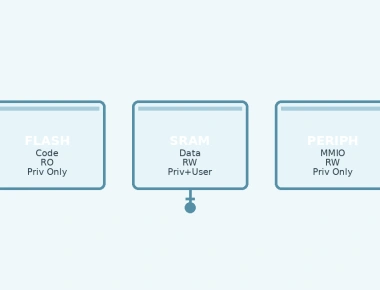
The bootloader resides in protected memory regions, typically at the beginning of flash memory. This location ensures it executes first after reset, as most microcontrollers are configured to start execution from a fixed address. The bootloader size is constrained by the available protected memory, requiring careful optimization to fit essential functionality within limited space.
Embedded systems often employ multi-stage bootloaders to balance functionality with size constraints. The first stage (stage 1) is a minimal loader that initializes only the most essential hardware (like clock settings and memory controller) to load the second stage from external memory. The second stage (stage 2) contains the main bootloader functionality including flash drivers, file system support, and update procedures.
Memory layout is critical in bootloader design. The bootloader must reside in a memory region that is protected from accidental overwrites during application updates. Common approaches include dedicating the first few kilobytes of flash to the bootloader or using separate memory banks. The application image typically follows the bootloader in memory, with additional space reserved for update buffers or backup images.
Proper hardware initialization is fundamental to bootloader reliability. The initialization sequence typically follows this order: clock configuration, memory controller setup, basic peripheral initialization (UART for debugging), and then more complex peripherals. Each step must include error handling and timeout mechanisms to prevent the system from hanging due to hardware faults.
Clock configuration is particularly important as it affects timing-sensitive operations. The bootloader must configure the system clock to stable frequencies before initializing any peripherals that depend on precise timing. Memory controller initialization ensures reliable access to both internal and external memory devices used for storing the bootloader, application, and data.
Since bootloaders frequently interact with flash memory for application loading and updates, implementing robust flash drivers is essential. The bootloader must support the specific flash architecture of the target microcontroller, including sector erasure, page programming, and read operations. Implementing wear leveling algorithms helps extend flash lifespan in applications with frequent updates.
Error detection and correction mechanisms are vital for flash operations. The bootloader should verify written data through read-back checks and implement checksums or CRCs to detect corruption. Power-fail protection during flash writes prevents leaving the memory in an inconsistent state that could prevent future boots.
Before transferring control to the application, the bootloader must validate the application image to ensure it is intact and compatible. This validation typically involves checking a header structure that contains information like image size, version, CRC checksum, and target addresses. If validation fails, the bootloader can initiate recovery procedures or enter a safe mode for diagnostics.
The actual jump to the application involves setting the stack pointer and program counter to the application’s reset handler address. Specifically on ARM Cortex-M microcontrollers, the bootloader reads the initial Main Stack Pointer (MSP) value from the first entry of the application’s vector table (at the application base address) and the Reset Vector address from the second entry (base + 4). The bootloader then disables all active peripherals, disables the SysTick timer, clears pending interrupts in the NVIC, updates the Vector Table Offset Register (SCB->VTOR) to point to the application’s vector table base, sets the MSP using the CMSIS intrinsic __set_MSP(), and finally calls the Reset Vector function pointer to jump to the application. This clean-slate transition ensures that no active peripheral or unhandled interrupt from the bootloader context disrupts the application’s initial execution.
In-field firmware updates are a critical feature enabled by bootloaders. The bootloader must provide a mechanism to receive new application images (via UART, USB, Ethernet, or other interfaces) and safely program them into flash memory. Implementing a fail-safe update process involves maintaining a backup of the current application and verifying the new image before committing the update.
Atomic update schemes use dual-bank approaches where the new application is written to a secondary bank while the current application remains active in the primary bank. After successful validation, the bootloader switches the active bank to the new image. This approach ensures that a power failure during update does not leave the system without a valid application.
Secure bootloaders protect against unauthorized firmware modifications and ensure only trusted code executes on the device. Implementing cryptographic signatures for application images prevents tampering and ensures integrity. The bootloader verifies the signature using a stored public key before allowing the application to execute.
Additional security measures include protecting the bootloader itself from rollback attacks, securing debug interfaces, and implementing secure key storage. Resource-constrained devices may require lightweight cryptographic algorithms and hardware acceleration to meet performance requirements.
Bootloader design is a foundational aspect of embedded system development that directly impacts product reliability, maintainability, and security. A well-designed bootloader provides essential hardware initialization, application validation, and update capabilities while occupying minimal memory space. Key considerations include multi-stage architectures for flexibility, robust flash management with error detection, secure validation mechanisms, and fail-safe update procedures. By following these principles, developers can create bootloaders that ensure their embedded products start reliably and remain serviceable throughout their lifecycle.
Quick Links
Legal Stuff