FreeRTOS Memory Pool: Zero-Copy Data Transfer
September 25, 2026
7 min
In safety-critical and security-sensitive embedded systems, a stray pointer or a buffer overflow in one task can corrupt the memory of another — leading to catastrophic failures that are incredibly difficult to debug. The Memory Protection Unit (MPU) is a hardware feature available on most ARM Cortex-M processors that provides a first line of defense against such memory access violations. By dividing the memory map into regions with individually configurable access permissions, the MPU can detect and trap illegal memory accesses before they cause irreparable damage.
This article explores how the MPU works, how to configure it, and how it integrates with real-time operating systems to create robust, fault-resilient firmware.
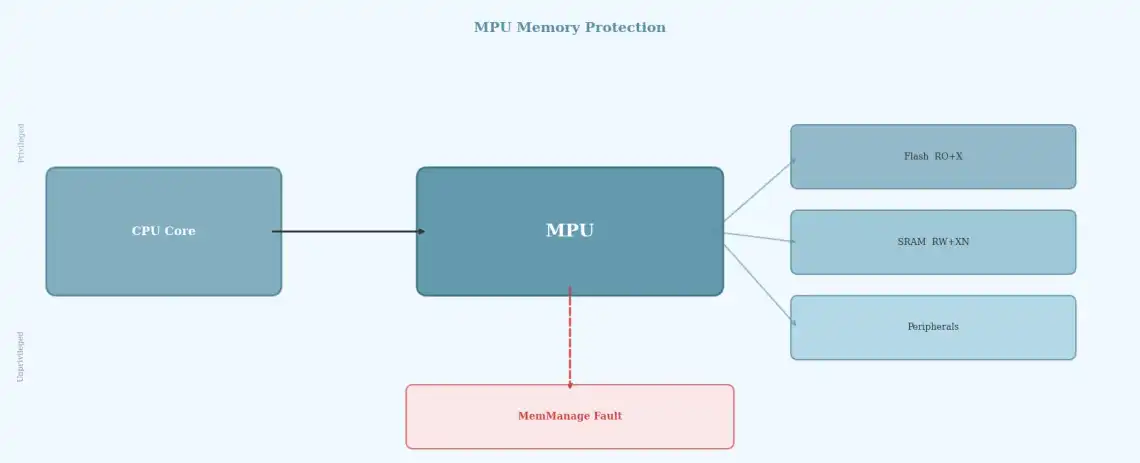
The MPU is an optional hardware unit integrated into ARM Cortex-M3, M4, M7, and some Cortex-M23/M33 processors. Cortex-M0/M0+ cores do not include a standard ARM MPU, though some vendors provide similar proprietary protection mechanisms. It monitors every memory access made by the CPU and compares it against a set of programmer-defined rules. If an access violates the configured permissions, the processor raises a Memory Management Fault (MemManage) exception, allowing the firmware to log the error, recover, or take corrective action.
Unlike a full Memory Management Unit (MMU) found in application processors, the MPU does not perform address translation or support virtual memory. It operates on the physical address map, making it lightweight and deterministic — ideal for real-time embedded applications.
The ARMv7-M MPU (found on Cortex-M3/M4/M7) supports up to eight independently configurable memory regions, each of which can be subdivided into eight subregions. The Cortex-M7 extends this to 16 regions, but this is implementation-dependent. Each region is configured using the following registers:
The MPU_CTRL (Control Register) enables the MPU and optionally activates the background region, which applies the default memory map to privileged accesses for addresses not covered by any MPU region.
The AP field in RASR controls read/write access for both privileged and unprivileged modes:
| AP Value | Privileged Mode | User Mode |
|---|---|---|
| 000 | No Access | No Access |
| 001 | Read/Write | No Access |
| 010 | Read/Write | Read Only |
| 011 | Read/Write | Read/Write |
| 100 | (Reserved) | (Reserved) |
| 101 | Read Only | No Access |
| 110 | Read Only | Read Only |
| 111 | Read Only | Read Only |
*Note: Some AP encodings (e.g., 111) may be implementation-defined but typically behave as read-only for both modes.
Setting the XN bit on a region prevents the processor from executing code from that memory area. This is critical for security: it prevents an attacker (or a bug) from executing data as code, thwarting code injection attacks.
A typical MPU configuration follows this sequence:
/* Step 1: Enable the MemManage fault exception */SCB->SHCSR |= SCB_SHCSR_MEMFAULTENA_Msk;/* Step 2: Configure Region 0 — Flash (Read-Only, Executable) */MPU->RNR = 0;MPU->RBAR = 0x08000000 | MPU_RBAR_VALID_Msk | 0;MPU->RASR = MPU_RASR_ENABLE_Msk| (0x13 << MPU_RASR_SIZE_Pos) /* 1MB region (Size = 19, 2^(19+1) = 1MB) */| (0x06 << MPU_RASR_AP_Pos) /* P:RO, U:RO */| (0x01 << MPU_RASR_TEX_Pos); /* Normal, cacheable *//* Step 3: Configure Region 1 — SRAM (Read/Write, No Execute) */MPU->RNR = 1;MPU->RBAR = 0x20000000 | MPU_RBAR_VALID_Msk | 1;MPU->RASR = MPU_RASR_ENABLE_Msk| (0x11 << MPU_RASR_SIZE_Pos) /* 256KB region (Size = 17, 2^(17+1) = 256KB) */| (0x03 << MPU_RASR_AP_Pos) /* P:RW, U:RW */| MPU_RASR_XN_Msk /* Execute Never */| (0x01 << MPU_RASR_TEX_Pos);/* Step 4: Configure Region 2 — Peripherals (Privileged Only) */MPU->RNR = 2;MPU->RBAR = 0x40000000 | MPU_RBAR_VALID_Msk | 2;MPU->RASR = MPU_RASR_ENABLE_Msk| (0x1C << MPU_RASR_SIZE_Pos) /* 512MB region (Size = 28, 2^(28+1) = 512MB) */| (0x01 << MPU_RASR_AP_Pos) /* P:RW, U:No Access */| MPU_RASR_XN_Msk| (0x02 << MPU_RASR_TEX_Pos); /* Device memory (via TEX/C/B configuration) *//* Step 5: Enable MPU with default background map for privileged code */MPU->CTRL = MPU_CTRL_ENABLE_Msk | MPU_CTRL_PRIVDEFENA_Msk;
Note: Memory type is determined by a combination of TEX, C, B, and S bits, not by TEX alone.
When two MPU regions overlap, the region with the higher number takes precedence. This allows you to create a broad base region and overlay more specific restrictions on top. For example, Region 0 might grant read-only access to the entire flash, while Region 1 carves out a smaller subregion within flash that is read/write for a bootloader’s writable data section.
Each region of size 256 bytes or larger is automatically divided into eight subregions of equal size. The SRD (Subregion Disable) field in RASR lets you individually disable subregions, effectively creating non-contiguous protection areas without consuming additional region slots.
The MPU truly shines when paired with an RTOS. In a typical RTOS configuration:
FreeRTOS, for example, offers an MPU-aware port (FreeRTOS-MPU) that manages region configuration automatically during context switches. When the scheduler switches tasks, it loads the new task’s MPU region into the MPU registers, ensuring each task sees only its permitted memory regions.
SCB_SHCSR_MEMFAULTENA_Msk, an MPU violation triggers a HardFault instead of a MemManage fault, making debugging harder.PRIVDEFENA unless you explicitly cover the entire address space.The Memory Protection Unit is one of the most underutilized features in embedded Cortex-M development. With just a handful of register writes, you can transform a fragile firmware into a resilient system that detects and contains memory access violations in real time. Whether you are building a safety-critical medical device, an automotive ECU, or an IoT product that needs to resist tampering, the MPU provides hardware-enforced memory protection with minimal performance overhead. Integrating it with your RTOS task model is the key to achieving true task isolation and system robustness.
Quick Links
Legal Stuff