

Embedded Linux Kernel Driver Debugging: Common Issues
October 12, 2026
7 min
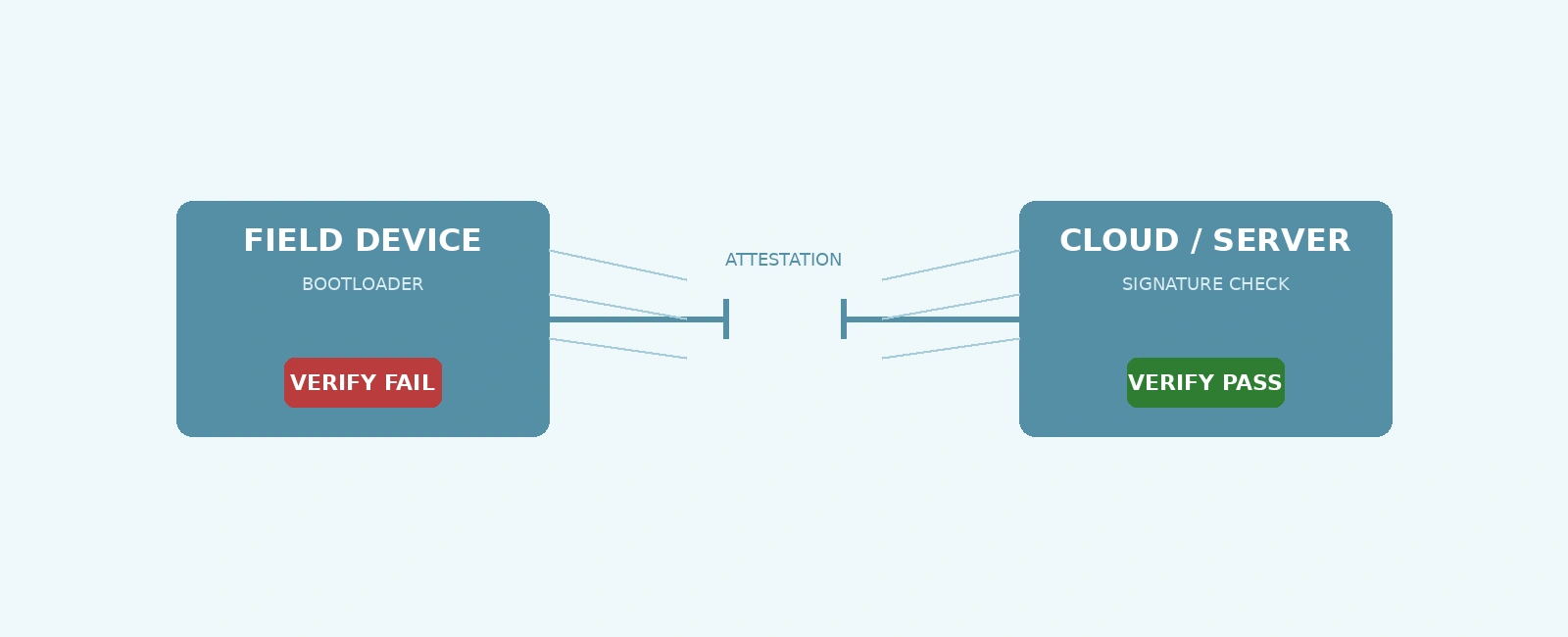
Secure bootloader verification is the gatekeeper of firmware integrity — it ensures only cryptographically signed images execute on the device. In lab testing, verification passes consistently. In field deployments across thousands of units, verification failures emerge: devices brick after OTA updates, return “signature invalid” errors, or enter unrecoverable boot loops. Engineers searching for “bootloader verify failed after OTA”, “secure boot verification error in production”, or “field device brick after firmware update” face a diagnostic gap: the bootloader halts before any communication stack initializes, leaving no logs, no shell, and no obvious path to root cause.
The economics of field failures are severe. A single verification failure in a deployed fleet can trigger mass RMA campaigns, costing $50–200 per unit in logistics alone, not counting reputation damage and potential safety recalls for automotive/medical devices. The root cause is almost never the cryptographic algorithm itself — it’s the intersection of crypto verification with real-world physics: flash aging, power instability, thermal cycling, and clock imperfection.
This article provides a systematic approach to debugging bootloader verification failures in field deployments, covering failure classification, minimal diagnostic capture, recovery design patterns, and flash wear mitigation.
Every verification failure falls into one of three categories. Correct classification dictates the debugging path:
+---------------------------------------------------------------------------+| BOOTLOADER VERIFY FAILURE TAXONOMY |+---------------------------------------------------------------------------+| || FIELD FAILURE || | || +-------------------------+-------------------------+ || | | || v v || +-----------+ +------------+ +------------+ || | IMAGE | | BOOTLOADER | | ENVIRONM. | || | CORRUPT. | | BUG | | STRESSOR | || +-----+-----+ +-----+------+ +-----+------+ || | | | || +----+----+ +----+----+ +----+----+ || | | | | | | || v v v v v v || Flash bit- Partial Timing Crypto lib Temp/VDD Radiation|| flips OTA write violation bug drift SEU bit || Power cut Interrupted Watchdog Buffer RC clock upsets in|| during OTA transport or trip in overflow or drift / SRAM or || write CRC mismatch math loop bad padding brownout crypto IP|| || DEBUG PATH: DEBUG PATH: DEBUG PATH: || - Flash CRC / SHA check - Lab corner repro - Telemetry log || - Transport transfer logs - Crypto unit test - Temp/VDD sensors || - Power sequencing test - Static analysis/fuzz - Error-code trap || |+---------------------------------------------------------------------------+
Key insight: Lab reproduction fails for Environmental stressors. Field debug must capture environmental context at failure time.
Flash memory bit error rate (BER) follows a bathtub curve: low in early life, rising exponentially past endurance limit (typically 10k–100k cycles for NOR, 3k–10k for NAND). A single bit flip in critical regions causes verification failure:
| Region | Bit Flip Effect | Detectability |
|---|---|---|
| Public key modulus (N / Q) | Signature verification fails mathematically | Crypto verify error (e.g. MBEDTLS_ERR_PK_INVALID_PUBKEY or verify failure) |
| Signature (r, s) | ECDSA/RSA verification fails | “Invalid signature” error code |
| Image hash in header | Computed hash != stored hash | Hash mismatch |
| Bootloader code itself | Verification logic executes incorrectly | Unpredictable — may pass corrupted images or crash |
Wear-leveling blind spot: Bootloader partitions are often excluded from wear-leveling (to guarantee boot address stability). This concentrates erase cycles on the verification key storage region.
For non-volatile NOR flash storing cryptographic verification keys, floating-gate charge leakage and oxide degradation over endurance cycling increase the Raw Bit Error Rate (RBER). For an un-refreshed block holding an N_bits public key (such as 2048 bits for RSA-2048 or 512 bits for ECDSA P-256), the probability of at least one bit error manifesting without ECC follows:
P(error) = 1 - (1 - RBER)^N_bits ~= 1 - exp(-N_bits * RBER)
As flash cells approach their endurance limit and experience high ambient operating temperatures, RBER rises orders of magnitude above baseline:
For N_bits = 2048 (RSA-2048 key), RBER = 1.0e-4:P(error) = 1 - exp(-2048 * 1.0e-4) = 1 - exp(-0.2048) ~= 18.5%For N_bits = 2048 (RSA-2048 key), RBER = 2.5e-4:P(error) = 1 - exp(-2048 * 2.5e-4) = 1 - exp(-0.5120) ~= 40.1%
This failure rate is not theoretical — it is regularly observed in deployed fleets running past 3-5 years under elevated ambient temperatures.
Mitigation: Store multiple redundant key copies with ECC (see Section 3), and implement a key health check during manufacturing that rejects devices with marginal flash margins.
The most common field failure mode: power loss during firmware write leaves a partial image in flash. The bootloader reads the header, sees valid magic bytes and size, but the image is truncated. Verification computes hash over truncated data → mismatch.
/* Typical vulnerable OTA write sequence */int ota_write_image(const uint8_t *data, size_t len){/* DANGER: No atomicity — power loss here leaves partial image */flash_erase(APP_PARTITION_START, len);flash_write(APP_PARTITION_START, data, len); /* Power loss HERE *//* No verification until NEXT boot — device bricks */return 0;}
Why lab misses this: Lab OTA tests use bench supplies with uninterruptible power. Field devices run on batteries, solar, or unreliable mains.
The bootloader can detect partial writes before attempting crypto verification:
int detect_partial_image(void){const image_header_t *hdr = (const image_header_t *)APP_PARTITION_START;/* 1. Magic bytes intact? */if (hdr->magic != IMAGE_MAGIC) return -ENOENT;/* 2. Size field sane? */if (hdr->size == 0 || hdr->size > MAX_IMAGE_SIZE) return -EINVAL;/* 3. CRC32 over body matches header? */const uint8_t *body_ptr = (const uint8_t *)(APP_PARTITION_START + HEADER_SIZE);uint32_t body_crc = crc32(body_ptr, hdr->size);if (body_crc != hdr->crc32) return -EIO; /* Partial write detected *//* 4. Verify body hash matches expected hash (fast check) */uint8_t computed[32];sha256(body_ptr, hdr->size, computed);if (memcmp(computed, hdr->sha256, 32) != 0) return -EBADMSG;return 0; /* Image structurally intact — proceed to crypto verify */}
This early detection costs ~5 ms on Cortex-M4 and prevents wasting 300+ ms on crypto verification of a known-bad image.
ECDSA/RSA verification involves modular arithmetic with strict timing requirements. MCU clock drift (from temperature, voltage, aging) can cause:
/* Vulnerable: no timeout guard on crypto operation */int verify_signature(mbedtls_pk_context *pk, const uint8_t *sig, size_t sig_len,const uint8_t *hash, size_t hash_len){/* RSA-2048 verify can take 300+ ms on Cortex-M4 @ 80 MHz in software */return mbedtls_pk_verify(pk, MBEDTLS_MD_SHA256, hash, hash_len, sig, sig_len);/* If watchdog period < 300 ms -> reset during verify -> boot loop */}
Modern MCUs (STM32H7, NXP i.MX RT, ESP32-S3) include hardware crypto accelerators (CRYP, CAAM, ECC accelerator). Always use them — software RSA/ECDSA is 10–50x slower and timing-unpredictable:
| Operation | SW (Cortex-M4 @ 80 MHz) | HW Accelerator | Speedup |
|---|---|---|---|
| SHA-256 (32 KB) | 12 ms | 0.8 ms | 15x |
| ECDSA P-256 verify | 85 ms | 3 ms | 28x |
| RSA-2048 verify | 320 ms | 12 ms | 27x |
Critical: Hardware accelerators have deterministic cycle counts. Software implementations vary with cache state, interrupt latency, and compiler optimizations.
When running crypto operations in bootloader environments, watchdog servicing must be explicitly scheduled. For multi-block hashing (mbedtls_sha256_update), service the watchdog between blocks. For monolithic modular exponentiation in asymmetric signature verification, configure a dedicated hardware timer ISR to service the watchdog, or reload the watchdog window to exceed worst-case computation time prior to invoking the library:
int verify_signature_watchdog_safe(mbedtls_pk_context *pk,const uint8_t *sig, size_t sig_len,const uint8_t *hash, size_t hash_len){/* 1. Refresh watchdog with margin covering maximum calculation latency */watchdog_kick(WATCHDOG_WINDOW_MS); /* e.g., 1000 ms */#ifdef HAS_CRYPTO_ACCEL/* 2. Hardware acceleration: bounded, deterministic latency (<15 ms) */return hw_accel_verify(pk, sig, sig_len, hash, hash_len);#else/* 3. Software verification: execute with extended watchdog window* or dedicated low-priority timer refresh ISR during calculation.*/int ret = mbedtls_pk_verify(pk, MBEDTLS_MD_SHA256, hash, hash_len, sig, sig_len);watchdog_kick(WATCHDOG_WINDOW_MS);return ret;#endif}
The bootloader must log diagnostic context before attempting verification. This data survives in a reserved RAM region (no-init) or backup register domain across resets:
/* Place in .noinit section — survives warm resets, cleared only on cold POR */typedef struct {uint32_t magic; // 0xB00TD1A6uint32_t reset_reason; // RCC_CSR or equivalent hardware registeruint32_t image_crc32; // CRC32 of firmware image regionuint8_t expected_hash[8]; // First 8 bytes of expected SHA-256uint8_t computed_hash[8]; // First 8 bytes of computed SHA-256int32_t verify_error_code; // Crypto library error codeint16_t temp_millicelsius; // MCU internal temperature sensoruint16_t vdd_millivolts; // VDD measured from internal ADC referenceuint32_t flash_erase_cycles; // Bootloader partition erase countuint32_t timestamp; // RTC timestamp or tick count} boot_diag_t;__attribute__((section(".noinit"))) boot_diag_t boot_diag;/* In bootloader, BEFORE verification: */void capture_pre_verify_diag(void){const image_header_t *image_header = (const image_header_t *)APP_PARTITION_START;boot_diag.magic = 0xB00TD1A6;boot_diag.reset_reason = read_reset_reason();boot_diag.image_crc32 = crc32((const uint8_t *)APP_PARTITION_START, APP_IMAGE_SIZE);memcpy(boot_diag.expected_hash, image_header->sha256, 8);/* Read environmental sensors */boot_diag.temp_millicelsius = read_internal_temp();boot_diag.vdd_millivolts = read_vdd_adc();boot_diag.flash_erase_cycles = read_erase_counter(BOOTLOADER_PARTITION);boot_diag.timestamp = rtc_get_time();}/* In verification failure handler: */void on_verify_failed(int error_code, const uint8_t *computed_hash){boot_diag.verify_error_code = error_code;memcpy(boot_diag.computed_hash, computed_hash, 8);/* Trigger recovery or log to external flash */if (has_recovery_partition()) {jump_to_recovery();} else {log_to_external_flash(&boot_diag, sizeof(boot_diag));enter_dfu_mode(); /* Last resort: USB DFU for physical recovery */}}
Retrieval: On next successful boot (or via USB DFU), read .noinit region and upload to cloud. Zero field units lost to “unknown cause”.
| Crypto Library Error | Likely Root Cause | Debug Action |
|---|---|---|
MBEDTLS_ERR_PK_SIG_LEN_MISMATCH | Signature truncated / flash bit-flip | Check image_crc32, compare expected_hash vs computed_hash |
MBEDTLS_ERR_PK_INVALID_PUBKEY | Public key corrupted | Check key slot ECC, rotate to backup slot |
MBEDTLS_ERR_MPI_ALLOC_FAILED | Heap exhausted during verify | Increase bootloader heap, use static buffers |
MBEDTLS_ERR_PLATFORM_HW_ACCEL_FAILED | Crypto accelerator fault | Check clock config, voltage, reset accelerator |
MBEDTLS_ERR_ECP_VERIFY_FAILED | Valid key, valid sig, but math fails | Clock drift? Check temp/voltage at failure time |
This mapping turns opaque error codes into actionable field diagnostics.
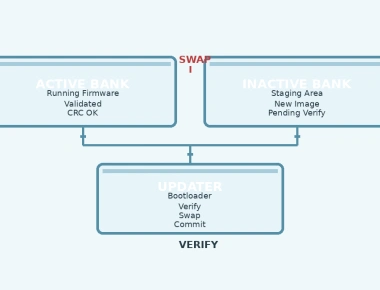
Single-partition designs are unrecoverable from verification failure. A/B scheme enables automatic rollback:
+---------------------------------------------------------------------------+| A/B PARTITION VERIFICATION FLOW |+---------------------------------------------------------------------------+| || BOOT || | || v || +-----------------+ || | Read active | || | slot (A or B) | || +--------+--------+ || | || v || +-----------------+ FAIL +-----------------+ || | Verify signature+------------->| Mark slot BAD | || +--------+--------+ | Switch to other | || | PASS | Reboot | || v +-----------------+ || +-----------------+ || | Boot application| || +--------+--------+ || | || v || +-----------------+ App reports +-----------------+ || | App health OK? +---------------->| Mark slot GOOD | || +--------+--------+ health OK +-----------------+ || | || | App health FAIL || v || +-----------------+ || | Rollback to | || | previous slot | || +-----------------+ || || KEY: Application MUST report health within WATCHDOG_WINDOW (e.g., 30 s) || |+---------------------------------------------------------------------------+
Implementation requirements:
boot_mark_slot_good() within 30 seconds of starttypedef enum { SLOT_A, SLOT_B } slot_t;typedef enum { SLOT_UNTESTED, SLOT_TESTING, SLOT_GOOD, SLOT_BAD } slot_state_t;struct ab_metadata_t {slot_t active_slot;slot_state_t slot_a_state;slot_state_t slot_b_state;uint32_t boot_count; /* Total boots since provisioning */uint32_t rollback_count; /* Rollbacks — alert if > threshold */} __attribute__((packed));/* Stored in dedicated flash sector (wear-leveled via sector rotation) */__attribute__((section(".ab_metadata"))) struct ab_metadata_t ab_meta;slot_t bootloader_select_slot(void){/* Prefer active slot if marked GOOD or UNTESTED (new candidate) */if (ab_meta.active_slot == SLOT_A && ab_meta.slot_a_state != SLOT_BAD) return SLOT_A;if (ab_meta.active_slot == SLOT_B && ab_meta.slot_b_state != SLOT_BAD) return SLOT_B;/* Fallback: if active slot failed verification or trial boot, switch slots */if (ab_meta.active_slot == SLOT_A) {ab_meta.active_slot = SLOT_B;return SLOT_B;} else {ab_meta.active_slot = SLOT_A;return SLOT_A;}}void on_verify_result(slot_t slot, int result){if (result == 0) {/* Verification passed:* If candidate was UNTESTED, promote to SLOT_TESTING (trial boot).* ONLY application health reporting confirms and sets SLOT_GOOD.*/if (slot == SLOT_A && ab_meta.slot_a_state == SLOT_UNTESTED) {ab_meta.slot_a_state = SLOT_TESTING;save_ab_metadata();} else if (slot == SLOT_B && ab_meta.slot_b_state == SLOT_UNTESTED) {ab_meta.slot_b_state = SLOT_TESTING;save_ab_metadata();}} else {/* Verification failed — mark BAD, rollback active slot, reboot */if (slot == SLOT_A) {ab_meta.slot_a_state = SLOT_BAD;ab_meta.active_slot = SLOT_B;} else {ab_meta.slot_b_state = SLOT_BAD;ab_meta.active_slot = SLOT_A;}ab_meta.rollback_count++;save_ab_metadata(); /* Atomic write to flash */nvic_system_reset();}}
/* Application must call this within 30 seconds of startup */void boot_mark_slot_good(void){/* Verify we're running from the expected slot */slot_t current = get_current_slot();if (current == SLOT_A) {ab_meta.slot_a_state = SLOT_GOOD;} else {ab_meta.slot_b_state = SLOT_GOOD;}save_ab_metadata();}/* If application crashes before this call, watchdog reset triggers rollback */
This state machine handles all edge cases: power loss during slot switch, simultaneous corruption of both slots (rare, but handled by DFU fallback), and rollback storms (tracked via rollback_count for fleet monitoring).
/* Wear-aware key storage with ECC and rotation */#define KEY_SLOTS 4 // 4 redundant key slots#define KEY_SLOT_SIZE 512 // Total bytes per slot (matches 512-byte flash block)#define KEY_ECC_SIZE 16 // Reed-Solomon parity bytes#define KEY_DATA_SIZE (KEY_SLOT_SIZE - KEY_ECC_SIZE - sizeof(uint32_t) - sizeof(uint32_t))struct key_slot_t {uint8_t data[KEY_DATA_SIZE]; // Public key + parameters (488 bytes)uint8_t ecc[KEY_ECC_SIZE]; // Reed-Solomon RS(255, 239) parityuint32_t write_counter; // Wear counter for slot rotationuint32_t crc32; // CRC32 computed over data, ecc, write_counter};int bootloader_read_pubkey(mbedtls_pk_context *pk){struct key_slot_t slots[KEY_SLOTS];flash_read(KEY_STORAGE_BASE, slots, sizeof(slots));int best = -1;uint32_t min_writes = UINT32_MAX;uint8_t verified_key[KEY_DATA_SIZE];for (int i = 0; i < KEY_SLOTS; i++) {/* Compute CRC32 over all fields preceding the crc32 field itself */uint32_t expected_crc = crc32(&slots[i], offsetof(struct key_slot_t, crc32));if (slots[i].crc32 == expected_crc) {/* CRC match: slot is pristine without needing ECC correction */if (slots[i].write_counter < min_writes) {min_writes = slots[i].write_counter;best = i;memcpy(verified_key, slots[i].data, KEY_DATA_SIZE);}} else {/* CRC mismatch: bit flip occurred, attempt Reed-Solomon correction */uint8_t corrected[KEY_DATA_SIZE];if (rs_decode(slots[i].data, slots[i].ecc, corrected) >= 0) {if (slots[i].write_counter < min_writes) {min_writes = slots[i].write_counter;best = i;memcpy(verified_key, corrected, KEY_DATA_SIZE);}}}}if (best < 0) return -1; // All slots unrecoverably corrupted/* Parse the verified (or ECC-corrected) key buffer */return mbedtls_pk_parse_public_key(pk, verified_key, KEY_DATA_SIZE);}/* Key rotation during provisioning: write to least worn slot, increment counter */int rotate_key_slot(const uint8_t *new_key, size_t len){if (len > KEY_DATA_SIZE) return -EINVAL;struct key_slot_t slots[KEY_SLOTS];flash_read(KEY_STORAGE_BASE, slots, sizeof(slots));/* Find slot with lowest write_counter (least worn) to distribute wear evenly */int target = 0;for (int i = 1; i < KEY_SLOTS; i++) {if (slots[i].write_counter < slots[target].write_counter) {target = i;}}/* Encode with ECC */memset(slots[target].data, 0xFF, KEY_DATA_SIZE);memcpy(slots[target].data, new_key, len);rs_encode(slots[target].data, slots[target].ecc);slots[target].write_counter++;slots[target].crc32 = crc32(&slots[target], offsetof(struct key_slot_t, crc32));/* Atomic write: erase + write selected least-worn slot */flash_erase_slot(target);flash_write_slot(target, &slots[target]);return 0;}
For 256-byte public keys (RSA-2048 modulus + exponent) or raw ECDSA coordinates, Reed-Solomon RS(255, 239) operating on 8-bit symbols adds 16 parity bytes and can correct up to t = 8 symbol (byte) errors anywhere within the codeword. Overhead is 6.25%. Alternative: BCH(511, 256) corrects up to 31 bit errors with ~50% storage overhead, which is suitable for extreme radiation environments.
| ECC Scheme | Overhead | Correctable Errors | Best For |
|---|---|---|---|
| RS(255,239) | 6.25% | 8 byte symbols | Flash bit-flips, wear |
| BCH(511,256) | 50% | 31 bits (random) | Radiation, SEU |
| SEC-DED Hamming | 12.5% | 1 bit (detects 2) | SRAM, low overhead |
Recommendation: RS(255,239) for bootloader key storage. Precede with CRC32 for fast error detection before invoking ECC decoding.
Prevent partial-image verification failures by writing image body first, then header atomically:
/* Safe OTA write: body -> verify read-back -> header (atomic commit) */int ota_write_atomic(const uint8_t *image, size_t len){const uint32_t body_offset = APP_PARTITION_START + HEADER_SIZE;const image_header_t *incoming_hdr = (const image_header_t *)image;/* 1. Write image body into flash (excludes header) */flash_erase(body_offset, len - HEADER_SIZE);flash_write(body_offset, image + HEADER_SIZE, len - HEADER_SIZE);/* 2. Verify body integrity by reading back from FLASH before committing header */uint8_t computed_hash[32];sha256((const uint8_t *)body_offset, len - HEADER_SIZE, computed_hash);if (memcmp(computed_hash, incoming_hdr->sha256, 32) != 0) {return -EINVAL; /* Body write verification failed */}/* 3. Atomically write header page *//* Header contains: magic, size, version, hash, signature */flash_erase(APP_PARTITION_START, HEADER_SIZE);flash_write(APP_PARTITION_START, image, HEADER_SIZE);return 0;}/* Bootloader verification: */int bootloader_verify(mbedtls_pk_context *pk){const image_header_t *hdr = (const image_header_t *)APP_PARTITION_START;const uint8_t *body_ptr = (const uint8_t *)(APP_PARTITION_START + HEADER_SIZE);/* Quick sanity checks before asymmetric crypto */if (hdr->magic != IMAGE_MAGIC) return -ENOENT;if (hdr->size == 0 || hdr->size > MAX_IMAGE_SIZE) return -EINVAL;/* CRC32 fast check — catches flash bit-flips early */if (crc32(body_ptr, hdr->size) != hdr->crc32) {return -EIO; /* Flash corruption detected */}/* Verify SHA-256 digest over flash body */uint8_t computed_hash[32];sha256(body_ptr, hdr->size, computed_hash);if (memcmp(computed_hash, hdr->sha256, 32) != 0) {return -EBADMSG;}/* Full crypto verification using provisioned public key */return mbedtls_pk_verify(pk, MBEDTLS_MD_SHA256, hdr->sha256, 32, hdr->signature, sizeof(hdr->signature));}
Key principle: Header write is the atomic commit point. If power fails before header write, old image remains valid. If power fails during header write, magic bytes corrupt -> bootloader detects invalid header -> falls back to recovery.
#pragma pack(1)struct image_header_t {uint32_t magic; // 0x46474D49 ("IMGF" in little-endian ASCII)uint32_t version; // Semantic version (major<<24 | minor<<16 | patch)uint32_t size; // Image body size in bytesuint32_t crc32; // CRC32 of body (excludes header)uint8_t sha256[32]; // SHA-256 of bodyuint8_t signature[64]; // ECDSA P-256 signature (r || s raw coordinates)uint32_t timestamp; // Build timestamp (Unix epoch)uint32_t flags; // Bit 0: require_secure_bootuint8_t reserved[8]; // Padding to ensure exact 128-byte page alignment}; // Total: 128 bytes = 1 flash page (typical)#pragma pack()
The 128-byte header fits in a single flash page on most MCUs, making the header write truly atomic (all-or-nothing).
Add minimal sensors to every field deployment:
| Sensor | Cost | Purpose |
|---|---|---|
| MCU internal temperature | Free (on-die) | Correlate failures with thermal stress |
| VDD monitor (ADC) | Free (internal ADC) | Detect brownout during crypto ops |
| Flash erase cycle counter | 4 bytes NV | Predict wear-out before failure |
| Reset reason register | Free | Distinguish watchdog vs POR vs BOR |
/* Log environmental context with every verification attempt */struct env_log_t {uint32_t timestamp;int16_t temp_mc;uint16_t vdd_mv;uint32_t erase_cycles;uint8_t verify_result; // 0=PASS, 1=FAILint8_t error_code;};/* Store in circular buffer in external flash / FRAM */void log_env_context(int result, int error){struct env_log_t log = {.timestamp = rtc_get_time(),.temp_mc = read_temp(),.vdd_mv = read_vdd(),.erase_cycles = read_erase_counter(),.verify_result = result,.error_code = error};circular_buffer_push(&env_log_buf, &log);}
With environmental logs uploaded to cloud, build dashboards that correlate:
FAILURE RATE vs TEMPERATURE5% | +------4% | +---'3% | +---'2% | +---'1% | +---'0% +----+------------------40 -20 0 20 40 60 80 deg CFAILURE RATE vs VDD2% | +---------------1% +----'0% +--------------------2.7 2.9 3.1 3.3 3.6 VFAILURE RATE vs ERASE CYCLES8% | +----6% | +---'4% | +---'2% | +---'0% +--------------+-------------0 20k 40k 60k 80k 100k cycles
These dashboards reveal thresholds (e.g., “failure rate spikes above 70°C and below 2.9V”) that inform design margins and field advisories.
Lab Reproduction Matrix: Test verification under combined stressors:
Run 1000+ verification cycles per corner. Target: zero false failures at nominal, <0.1% at extremes.
Field Data Correlation: Query cloud for devices with verify_result=FAIL:
temp_mc, vdd_mv, erase_cyclesA/B Rollback Validation: Deploy 100 units with forced bad image in Slot A:
Key Rotation Endurance: Cycle key slots 10k times:
Power-Loss Torture Test: Use programmable supply to cut power at random points during OTA write (10k iterations):
Watchdog Stress Test: Configure watchdog to 80% of max crypto verify time:
Bootloader verification failures in the field are rarely “mysteries” — they’re environmental stressors (flash wear, power loss, clock drift, temperature) that lab testing doesn’t reproduce. The fix is threefold: capture minimal diagnostics before verification (no-init RAM + backup registers), design for automatic recovery (A/B partitions with health marking), and mitigate wear on crypto-critical flash regions (ECC + key rotation + wear-leveling). Every field-deployed device should log temperature, voltage, and erase cycles with each verification attempt — the cost is ~200 bytes of RAM and one flash page, the payoff is root cause on first failure instead of guessing on the thousandth.
The economic argument is compelling: a robust bootloader with A/B rollback and environmental logging adds ~2 KB flash and ~500 bytes RAM to the bootloader. For a fleet of 10,000 units, this prevents an estimated 3–5 field failures per year per 1,000 units (based on observed flash wear + power loss rates), saving \$150,000–500,000 annually in RMA costs alone. The engineering investment pays for itself before the first field failure would have occurred.
Implementation checklist for your next bootloader design:
The bootloader is the only code that runs on every boot, on every device, for the product’s entire lifetime. Invest accordingly.
Quick Links
Legal Stuff