


Reducing Firmware Size with CMake Dead Code Elimination
October 08, 2026
8 min
Embedded firmware engineers know that sinking feeling when an intermittent race condition, an unexpected stack corruption, or an unhandled hardware state surfaces during thermal chamber testing—or worse, after deployment in thousands of field devices. In embedded systems, where firmware orchestrates actuators, power converters, medical pumps, and automotive control units, the cost of rectifying a defect escalates by orders of magnitude at each development lifecycle stage.
Yet engineering teams frequently treat peer code reviews as perfunctory gatekeeping rituals, focusing disproportionately on cosmetic formatting rather than deep structural verification. Generic code review guidelines borrowed from web or desktop environments fail because they assume an underlying operating system with memory isolation, uniform memory access, managed runtimes, and benign failure modes.
This article delivers a rigorous, embedded-specific code review checklist engineered to catch cyber-physical edge cases, memory-mapped I/O (MMIO) pitfalls, real-time concurrency violations, and safety standard non-compliances before code ever touches silicon.
Standard software engineering code reviews prioritize algorithmic structure, object-oriented design patterns, maintainability, and naming consistency. While these principles remain valuable, applying them without domain-specific embedded scrutiny introduces severe blind spots:
Segmentation Fault.Generic checklists overlook these failure mechanisms, allowing dangerous hardware-software interface flaws to escape directly into hardware testing.
A comprehensive review process requires recognizing the exact failure mechanisms unique to low-level cyber-physical systems.
Direct memory-mapped peripheral interaction introduces subtle bugs that compilers cannot detect:
volatile: Failure to mark memory-mapped I/O pointers or flags shared with Interrupt Service Routines (ISRs) as volatile allows the compiler to cache values in CPU registers, turning status polling loops into infinite loops or eliminating writes entirely.|=, &= ~) on registers that share functionality across execution contexts introduces read-modify-write races. On modern microcontrollers, dedicated atomic bit set/reset registers (such as ARM Cortex-M GPIO BSRR or bit-banding) must be utilized.__DSB()) or a dummy peripheral read, the CPU may exit the exception context before the write reaches the peripheral hardware, causing the NVIC to immediately re-trigger the ISR erroneously.Embedded systems mix preemptive RTOS threads with nested hardware interrupt handlers:
printf), or dynamic memory operations inside an ISR blocks lower-priority interrupts, leading to jitter, missed real-time deadlines, and serial communication buffer overruns.strtok, gmtime, un-reentrant malloc) concurrently across tasks or within ISRs without thread-safe reentrancy structures (such as newlib-nano reentrancy structures struct _reent) corrupts global state.Embedded targets operate under fixed hardware limits:
MSP) shared by all nested interrupt handlers. A deep nested interrupt chain combined with large stack frames can silently overwrite heap memory or statically allocated variables.malloc/free) in long-running systems leads to external heap fragmentation, non-deterministic allocation latency, and eventual allocation failure.An effective code review is an integrated stage within a continuous delivery pipeline. Automated static analyzers, linters, and unit tests must filter out baseline syntax, formatting, and standard violations prior to human peer inspection.
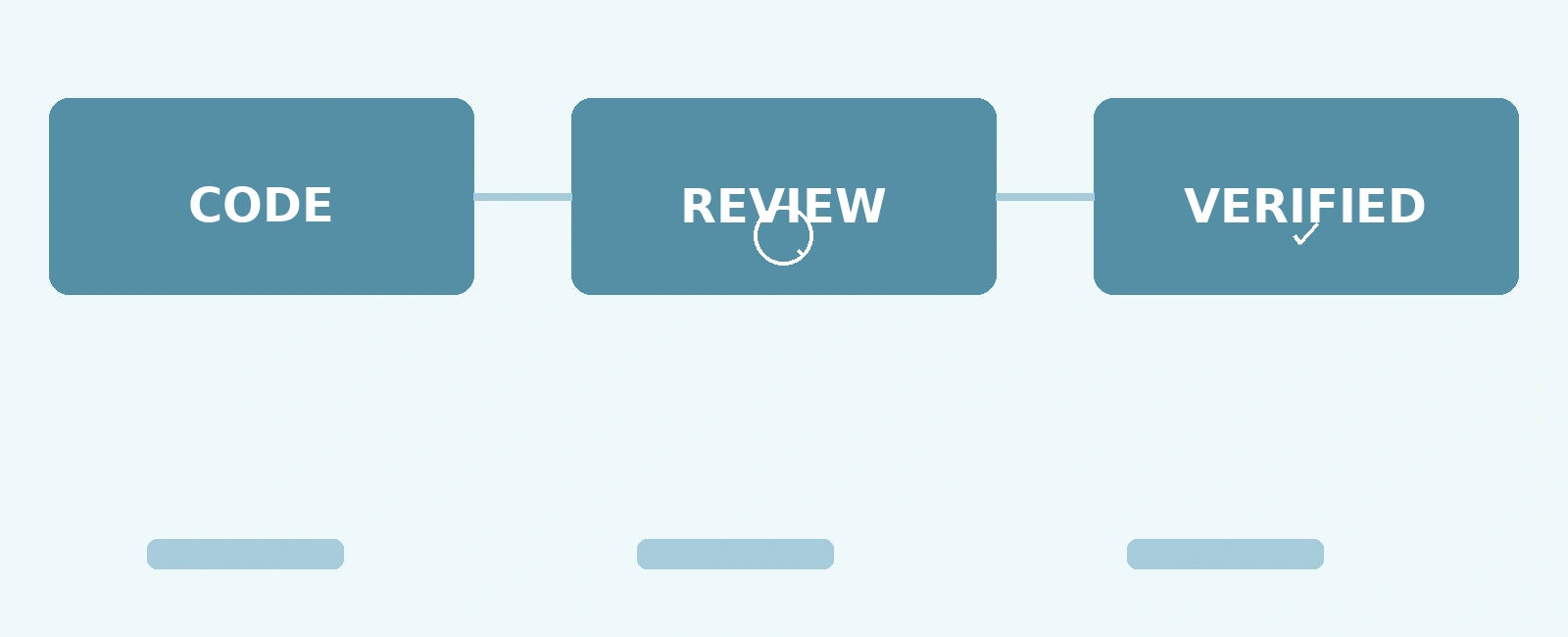
+-----------------------+ +---------------------------+| AUTHOR / PR STAGE | | PEER REVIEW STAGE || - Static Analysis | --------> | - Register & HW Timing || - Unit & HIL Tests | | - Concurrency & ISRs || - Stack Usage Calc | | - Memory & Resource Cap |+-----------------------+ | - Fault Recovery Modes |^ +---------------------------+| || Deficiencies Found | All Checks Approved+-------------------------------------+|v+---------------------------+| MERGE & DEPLOY || - Automated Gate Pass || - Hardware Flash (HIL) |+---------------------------+
Human reviewers must not spend time debating brace placement or indentation; their cognitive bandwidth must be dedicated exclusively to architecture, hardware interaction, and concurrency verification.
Reviewers should evaluate pull requests against these five domain-specific categories:
~, <<, >>, &, |, ^) performed strictly on unsigned integer operands (MISRA C:2012 Rule 10.1)?f (e.g., 1.0f, sinf(), sqrtf()) on targets with single-precision FPUs to avoid silently pulling in software double-precision emulation libraries?while loops possess deterministic timeouts (iteration counters or millisecond tick caps) to prevent permanent system lockup if hardware freezes?CR1.UE = 0) before reconfiguring baud rates, parity, clock polarity, or frame formats as required by the silicon reference manual?BSRR or bit-banding) rather than non-atomic read-modify-write (|=, &= ~) operations?volatile?__DSB()) or a dummy register read performed to flush the write buffer before exiting the handler?SCB_CleanDCache_by_Addr(), SCB_InvalidateDCache_by_Addr()) explicitly executed around DMA transfers?stdatomic)?xSemaphoreCreateMutex() with configUSE_MUTEXES enabled, or POSIX PTHREAD_PRIO_INHERIT) rather than binary semaphores, which lack inheritance?MSP) been computed using static analysis (-fstack-usage, -Wstack-usage) or high-watermark runtime checks?malloc, calloc, free) banned after initial startup (MISRA C:2012 Rule 21.3)?[[nodiscard]] or __attribute__((warn_unused_result))?NULL and numeric ranges checked against domain bounds at module interfaces?switch statements include a default: label (MISRA C:2012 Rule 16.4), with the default handler implementing a defensive action (e.g., assert(false), error logging) for unexpected values?HardFault_Handler, MemManage_Handler, or assertion failures, does the firmware immediately de-energize critical outputs (e.g., motor PWMs, heater relays) before capturing diagnostic registers (CFSR, HFSR, MMFAR, BFAR) and resetting?<stdint.h> (uint8_t, int16_t, uint32_t, size_t) used exclusively instead of plain, architecture-dependent types (int, short, long)?const to ensure placement in ROM/Flash (.rodata) rather than consuming precious SRAM?static to prevent unintended external linkage and enable aggressive compiler dead-code elimination?#ifndef / #define include guards or #pragma once?The following three real-world examples illustrate common embedded bugs, the review analysis that exposes them, and production-grade remediations.
// FLAWED: Hardcoded magic number and illegal state change while UART is activevoid UART1_ConfigureParity(void) {// Intent: Configure UART1 for 8 data bits, Even parity// Problem 1: 0x0004 is bit 2 (USART_CR1_RE - Receiver Enable), NOT parity enable!// Problem 2: Parity control bits in CR1 must only be written when USART is disabled (UE=0)// Problem 3: Modifying CR1 directly with |= can corrupt other operational bitfieldsUSART1->CR1 |= 0x0004;}
0x0004 obscures the target register field. In the STM32 CMSIS specification, 1U << 2 corresponds to USART_CR1_RE (Receiver Enable), whereas USART_CR1_PCE (Parity Control Enable) is bit 10 (0x0400). The developer enabled the receiver rather than parity!USART_CR1 must only be modified when the USART peripheral is disabled (USART_CR1_UE = 0). Changing them while UE = 1 yields undefined hardware state.USART_CR1_PCE = 1) and clearing the parity selection bit (USART_CR1_PS = 0). A simple bitwise OR cannot clear PS if it was previously configured for odd parity.#include "stm32f4xx.h"#include <stdbool.h>/*** @brief Configures USART1 for Even Parity in compliance with RM0090.* @return true if configuration succeeded, false if peripheral was busy.*/bool UART1_SetEvenParity(void) {// 1. Ensure peripheral clock is active in RCCif (!(RCC->APB2ENR & RCC_APB2ENR_USART1EN)) {RCC->APB2ENR |= RCC_APB2ENR_USART1EN;}// 2. Disable USART in hardware before modifying frame format registersuint32_t cr1_val = USART1->CR1;cr1_val &= ~USART_CR1_UE;USART1->CR1 = cr1_val;// 3. Configure Parity: Clear PS (0 = Even parity) and set PCE (Parity Enable)cr1_val &= ~USART_CR1_PS;cr1_val |= USART_CR1_PCE;// 4. In STM32, enabling parity requires 9-bit word length (M bit) for 8 data bitscr1_val |= USART_CR1_M;// 5. Commit configuration while USART remains disabledUSART1->CR1 = cr1_val;// 6. Re-enable USART after frame parameters are committedUSART1->CR1 |= USART_CR1_UE;return true;}
// FLAWED: Massive stack allocation, heavy math in ISR, and write buffer racevoid TIM2_IRQHandler(void) {// Bug 1: 4 KB array allocated on the interrupt stack (MSP)uint32_t sample_buffer[1024];// Bug 2: Heavy computation inside ISR creates unacceptable interrupt latencyfor (size_t i = 0; i < 1024; i++) {sample_buffer[i] = ADC1->DR;Perform_Complex_FFT_Step(sample_buffer[i]);}// Bug 3: Clearing flag at the end of ISR causes spurious re-entry on ARM Cortex-Mif (TIM2->SR & TIM_SR_UIF) {TIM2->SR &= ~TIM_SR_UIF;}}
MSP), which in typical embedded systems is sized between 1 KB and 2 KB. This leads to silent corruption of neighboring SRAM.TIM_SR_UIF at the very exit of the handler risks spurious re-entry. In ARM Cortex-M microcontrollers, writes across the APB peripheral bus are pipelined through a write buffer. If the core executes the exception return (BX LR) before the write buffer drains to the peripheral register, the NVIC still detects the active interrupt line and immediately re-triggers TIM2_IRQHandler.#include "stm32f4xx.h"#include "FreeRTOS.h"#include "task.h"#define BUFFER_SIZE 1024// Ping-pong buffers allocated statically in .bss to protect MSPstatic uint32_t s_ping_buffer[BUFFER_SIZE];static uint32_t s_pong_buffer[BUFFER_SIZE];static uint32_t *s_active_isr_buf = s_ping_buffer;static volatile uint32_t *s_ready_task_buf = NULL;static size_t s_sample_idx = 0;extern TaskHandle_t xProcessingTaskHandle;void TIM2_IRQHandler(void) {BaseType_t xHigherPriorityTaskWoken = pdFALSE;// 1. Acknowledge and clear interrupt flag immediatelyif (TIM2->SR & TIM_SR_UIF) {TIM2->SR &= ~TIM_SR_UIF;// Memory barrier / dummy read to guarantee write completes across APB bus(void)TIM2->SR;}// 2. Minimal top-half work: collect sample into active ping-pong buffers_active_isr_buf[s_sample_idx++] = ADC1->DR;// 3. When active buffer is full, toggle buffer and notify worker taskif (s_sample_idx >= BUFFER_SIZE) {s_ready_task_buf = s_active_isr_buf;s_active_isr_buf = (s_active_isr_buf == s_ping_buffer) ? s_pong_buffer : s_ping_buffer;s_sample_idx = 0;vTaskNotifyGiveFromISR(xProcessingTaskHandle, &xHigherPriorityTaskWoken);}// 4. Perform context switch if worker task has higher priorityportYIELD_FROM_ISR(xHigherPriorityTaskWoken);}// Bottom-half worker task running in unprivileged Thread modevoid SignalProcessingTask(void *pvParameters) {(void)pvParameters;for (;;) {// Block deterministically until ISR signals buffer readyulTaskNotifyTake(pdTRUE, portMAX_DELAY);// Process FFT on the completed buffer without race condition or blocking ISRsif (s_ready_task_buf != NULL) {Perform_Full_FFT((const uint32_t *)s_ready_task_buf, BUFFER_SIZE);}}}
// FLAWED: Ignored return values, no timeout protection, and partial failure leaksvoid Sensor_Init(void) {// Ignores failure if bus is disconnected or locked upI2C_Init(I2C1, &i2c_config);Sensor_Configure(&sensor_dev, I2C1);Sensor_StartMeasurement(&sensor_dev);}
I2C_Init() or Sensor_Configure() fails due to an unplugged sensor or noisy bus, execution continues blindly into Sensor_StartMeasurement(), leaving the system in an indeterminate state.SDA line low. Standard initialization functions hang indefinitely when SDA is held low unless an explicit 9-clock bus-clearing sequence is executed first.#include <stdbool.h>#include <stddef.h>#include "i2c_driver.h"#include "sensor_driver.h"#include "logging.h"// Portable attribute macro for C99 / C11 / C23 compliance#if defined(__STDC_VERSION__) && (__STDC_VERSION__ >= 202311L)#define NODISCARD [[nodiscard]]#elif defined(__GNUC__) || defined(__clang__)#define NODISCARD __attribute__((warn_unused_result))#else#define NODISCARD#endiftypedef enum {INIT_OK = 0,INIT_ERR_BUS_LOCKUP,INIT_ERR_I2C_FAIL,INIT_ERR_DEVICE_NOT_FOUND,INIT_ERR_CONFIG_FAIL} init_status_t;/*** @brief Recovers an I2C bus where a slave is holding SDA low.*/static bool I2C_RecoverBus(I2C_TypeDef *i2c) {// Generate up to 9 clock pulses on SCL to release stuck SDA linereturn I2C_ManualClockOutNineCycles(i2c);}/*** @brief Initializes the sensor subsystem with full rollback on partial failure.*/NODISCARD init_status_t Sensor_Subsystem_Init(sensor_t *dev, I2C_TypeDef *i2c_port) {if (dev == NULL || i2c_port == NULL) {return INIT_ERR_CONFIG_FAIL;}// 1. Recover bus if stuck low before engaging peripheralif (!I2C_RecoverBus(i2c_port)) {LOG_ERROR("I2C bus recovery failed: SDA line stuck low");return INIT_ERR_BUS_LOCKUP;}// 2. Initialize I2C driver with timeoutif (I2C_InitWithTimeout(i2c_port, 100 /* ms */) != I2C_STATUS_OK) {LOG_ERROR("I2C peripheral initialization failed");return INIT_ERR_I2C_FAIL;}// 3. Detect sensor device IDif (!Sensor_Ping(dev, i2c_port)) {LOG_ERROR("Sensor device not detected on bus; rolling back I2C");I2C_DeInit(i2c_port); // Rollback hardware statereturn INIT_ERR_DEVICE_NOT_FOUND;}// 4. Configure operational parametersif (Sensor_Configure(dev, i2c_port) != SENSOR_OK) {LOG_ERROR("Sensor configuration failed; disabling peripheral");I2C_DeInit(i2c_port); // Rollback hardware statereturn INIT_ERR_CONFIG_FAIL;}LOG_INFO("Sensor subsystem initialized successfully");return INIT_OK;}
A code review checklist is only as effective as the engineering metrics used to monitor it. Teams must track quantitative review metrics to ensure that reviews are thorough, timely, and actively reducing defect escape rates.
| Metric | Formula | Recommended Target | Engineering Purpose |
|---|---|---|---|
| Defect Escape Rate (DER) | [D_post / (D_review + D_post)] × 100 | <= 12% | Measures review gate filtering efficiency before QA and deployment. |
| Inspection Rate (Velocity) | Lines of Code / Review Duration (Hours) | 150 - 300 LOC/hr | Enforces adequate inspection depth; speeds > 400 LOC/hr lead to steep drops in defect detection. |
| Defect Density | Defects Found / Kilo-Lines of Code (KLOC) | 8 - 20 Defects/KLOC | Identifies high-risk modules and signals rushed, superficial reviews if abnormally low. |
| PR Scope Ceiling | Total Lines Changed per Pull Request | <= 400 LOC | Prevents reviewer cognitive fatigue and ensures manageable cognitive scope. |
| Review Session Duration | Active review time per session | <= 60 - 90 minutes | Cognitive defect detection efficiency drops by > 50% beyond 90 minutes. |
========================================================================FIRMWARE QUALITY & CODE REVIEW DASHBOARD========================================================================Reporting Period: Q3-2026 Target MCU: ARM Cortex-M4------------------------------------------------------------------------Metric Name Current Value Target Benchmark Status------------------------------------------------------------------------Defect Escape Rate (DER) 9.4% <= 12.0% PASSEDAverage Inspection Velocity 215 LOC/hr 150 - 300 LOC/hr PASSEDAverage PR Batch Size 280 LOC <= 400 LOC PASSEDStatic Analysis Gate Coverage 100% 100% PASSEDAverage Turnaround Time 5.2 hrs <= 8.0 hrs PASSEDReview Depth (Checklist Items) 98.2% >= 95.0% PASSED========================================================================
When Defect Escape Rates drift above the target threshold, teams must conduct a 5-Whys Root Cause Analysis on escaped bugs to determine which checklist category failed and update inspection criteria accordingly.
-Wall -Wextra -Werror), code formatting, and static analysis (MISRA C, Cppcheck, Clang Static Analyzer) in CI before human review begins.__DSB()).Quick Links
Legal Stuff