

Embedded Firmware Code Coverage Analysis on Target Hardware
August 02, 2026
3 min
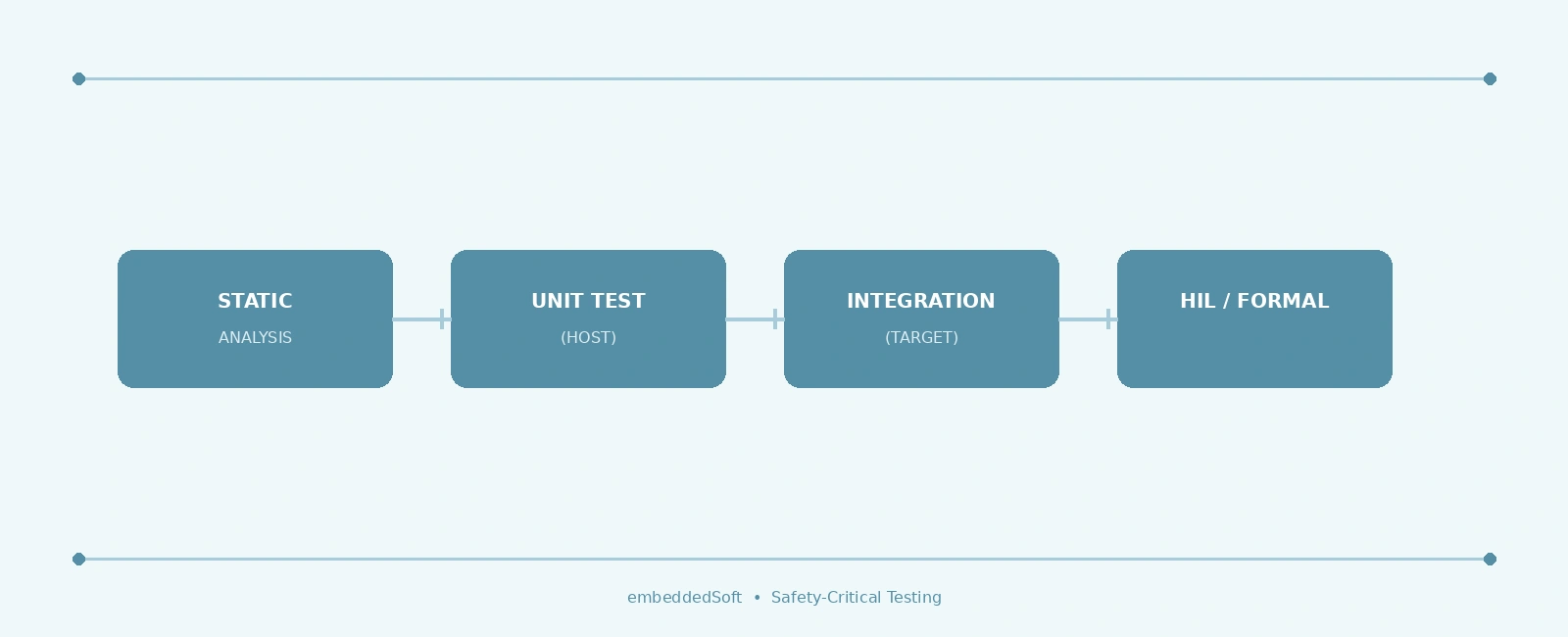
Testing safety-critical embedded firmware demands a layered verification strategy that spans host-based unit testing, target-based integration testing, hardware-in-the-loop simulation, and formal verification. The cost of a field failure in automotive, aerospace, or medical devices far exceeds the investment in rigorous test infrastructure. This article presents a practical testing pyramid tailored for ISO 26262, DO-178C, and IEC 61508 compliance.
Traditional testing pyramids emphasize many unit tests, fewer integration tests, and minimal end-to-end tests. Safety-critical embedded systems augment this model: while the wide base of unit tests remains essential for reaching 100% MC/DC coverage practically, target-based testing is equally critical because host simulation cannot replicate timing, memory protection, and hardware interaction faithfulness.
+--------------------------------------------------+| FORMAL VERIFICATION | <- Model checking, static analysis, theorem proving| (High confidence) |+--------------------------------------------------+| HARDWARE-IN-THE-LOOP (HIL) | <- Real-time plant simulation, fault injection| (System validation) |+--------------------------------------------------+| TARGET INTEGRATION TESTING | <- Real hardware, peripheral interaction, timing| (Module integration) |+--------------------------------------------------+| HOST UNIT TESTING | <- Fast feedback, mocked HAL, high coverage| (Module verification) |+--------------------------------------------------+| STATIC ANALYSIS / LINTING | <- MISRA, CERT, abstract interpretation| (Early defect detection) |+--------------------------------------------------+
Each layer catches different defect classes. Static analysis finds coding standard violations and undefined behavior. Unit tests verify algorithmic correctness with mocked peripherals. Integration tests expose hardware-software interface defects. HIL validates system behavior under realistic timing and fault conditions. Formal verification provides mathematical guarantees for critical algorithms.
Unit tests must run in milliseconds on CI runners without target hardware. This requires a Hardware Abstraction Layer (HAL) that cleanly separates business logic from register manipulation.
/* hal_gpio.h -- Hardware abstraction for GPIO */#ifndef HAL_GPIO_H#define HAL_GPIO_H#include <stdint.h>#include <stdbool.h>typedef enum { GPIO_LOW, GPIO_HIGH } gpio_state_t;typedef struct {void (*write)(uint32_t port, uint8_t pin, gpio_state_t state);gpio_state_t (*read)(uint32_t port, uint8_t pin);void (*toggle)(uint32_t port, uint8_t pin);} gpio_hal_t;/* Production implementation */extern const gpio_hal_t gpio_hal_stm32;/* Test mock implementation */extern const gpio_hal_t gpio_hal_mock;#endif /* HAL_GPIO_H */
/* led_controller.c -- Business logic using HAL */#include "hal_gpio.h"static const gpio_hal_t *gpio_hal;void led_controller_init(const gpio_hal_t *hal) {gpio_hal = hal;}void led_controller_set(uint8_t led_id, bool on) {static const uint32_t ports[] = { GPIOA_BASE, GPIOB_BASE };static const uint8_t pins[] = { 5, 3 };if ((gpio_hal != NULL) && (led_id < (sizeof(ports) / sizeof(ports[0])))) {gpio_hal->write(ports[led_id], pins[led_id], on ? GPIO_HIGH : GPIO_LOW);}}
/* test_led_controller.c -- Unity test with mock HAL */#include "unity.h"#include "led_controller.h"#include "mock_gpio_hal.h"void setUp(void) {mock_gpio_hal_reset();led_controller_init(&gpio_hal_mock);}void test_led_controller_set_high_writes_gpio_high(void) {mock_gpio_hal_expect_write(GPIOA_BASE, 5, GPIO_HIGH);led_controller_set(0, true);TEST_ASSERT_TRUE(mock_gpio_hal_verify());}void test_led_controller_set_low_writes_gpio_low(void) {mock_gpio_hal_expect_write(GPIOA_BASE, 5, GPIO_LOW);led_controller_set(0, false);TEST_ASSERT_TRUE(mock_gpio_hal_verify());}
Key practices:
Integration tests run on the target MCU with real peripherals. They verify:
/* test_uart_dma_integration.c -- Target integration test */#include <string.h>#include "unity.h"#include "uart_driver.h"#include "dma_driver.h"#include "stm32h7xx_hal.h"#define TEST_BUFFER_SIZE 64/* Buffers must be in non-cacheable memory for Cortex-M7 (STM32H7) DMA coherence */__attribute__((section(".noncacheable"))) static uint8_t tx_buffer[TEST_BUFFER_SIZE];__attribute__((section(".noncacheable"))) static uint8_t rx_buffer[TEST_BUFFER_SIZE];static volatile bool tx_complete = false;static volatile bool rx_complete = false;void HAL_UART_TxCpltCallback(UART_HandleTypeDef *huart) {tx_complete = true;}void HAL_UART_RxCpltCallback(UART_HandleTypeDef *huart) {rx_complete = true;}void setUp(void) {memset(tx_buffer, 0xA5, TEST_BUFFER_SIZE);memset(rx_buffer, 0, TEST_BUFFER_SIZE);tx_complete = false;rx_complete = false;uart_driver_init(USART3, 115200);dma_driver_init(DMA1, DMA_STREAM_1, DMA_STREAM_2);}void test_uart_dma_loopback_transfer(void) {/* Connect TX to RX externally (loopback plug) */uart_driver_transmit_dma(tx_buffer, TEST_BUFFER_SIZE);uart_driver_receive_dma(rx_buffer, TEST_BUFFER_SIZE);uint32_t start_tick = HAL_GetTick();while (!tx_complete || !rx_complete) {TEST_ASSERT_TRUE((HAL_GetTick() - start_tick) < 1000);}TEST_ASSERT_EQUAL_HEX8_ARRAY(tx_buffer, rx_buffer, TEST_BUFFER_SIZE);}
Integration test infrastructure requirements:
HIL connects the target ECU to a real-time simulator (dSPACE, NI VeriStand, Speedgoat, or custom FPGA-based) that models plant dynamics. The ECU runs production firmware; the simulator provides sensor inputs and consumes actuator outputs.
+------------------+ CAN/FlexRay/Ethernet +------------------+| TARGET ECU | <------------------------------> | REAL-TIME || (Production FW) | Sensor/Actuator Signals | SIMULATOR || | | (Plant Model) || - MCU + FW | | || - Peripherals | | - Engine model || - I/O drivers | | - Vehicle dyn. |+------------------+ | - Fault models |+------------------+
HIL test categories:
| Category | Purpose | Example |
|---|---|---|
| Nominal operation | Verify control loops under normal conditions | PID torque control tracks setpoint ±2% |
| Boundary conditions | Test limits: max RPM, min voltage, temp extremes | Cold crank at -40°C, battery 6V |
| Fault injection | Inject sensor faults, communication errors, actuator stuck | Short-to-battery on throttle position sensor |
| Timing validation | Measure ISR latency, task jitter, end-to-end delay | Crank sensor ISR < 5µs at 8000 RPM |
| Regression suites | Replay recorded vehicle maneuvers | WLTC cycle replay, fault scenario replay |
Fault injection techniques:
| Standard | Level | Required Coverage |
|---|---|---|
| ISO 26262 | ASIL-D | Statement, Branch, MC/DC |
| DO-178C | Level A | Statement, Decision, MC/DC |
| IEC 61508 | SIL 4 | Statement, Branch, MC/DC |
MC/DC (Modified Condition/Decision Coverage) requires each condition in a decision to independently affect the outcome. For if (A && (B || C)), test vectors must show:
Toolchain for target coverage:
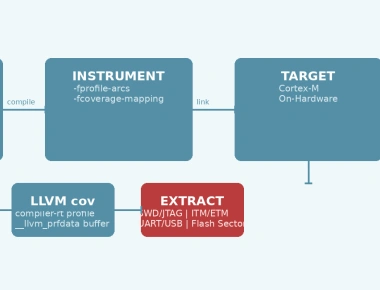
-fprofile-arcs -ftest-coverage or LLVM SanitizerCoverage.libgcov on target (requires ~8KB RAM for counters) or hardware trace (ETM/PTM) for zero-overhead.gcovr, lcov, or qualified tools (LDRA, Rapita, VectorCAST) for certification evidence.Practical coverage workflow:
# 1. Compile with coverage flagsarm-none-eabi-gcc -fprofile-arcs -ftest-coverage -fprofile-info-section -O0 -g -o firmware.elf src/*.c# Note: Linker script must KEEP .gcov_info sections (see GCC bare-metal gcov documentation)# 2. Flash and run test suite on targetopenocd -f interface/stlink.cfg -f target/stm32h7x.cfg \-c "program firmware.elf verify reset exit"# 3. Extract coverage data via semihosting or custom I/O wrapperarm-none-eabi-gdb firmware.elf -ex "target remote :3333" \-ex "monitor arm semihosting enable" \-ex "continue" \-ex "quit"# (Assuming libgcov writes .gcda files directly to host via semihosting)# 4. Generate reportgcovr -r . --html --html-details -o coverage.html
Static analysis catches defects before test execution. Mandatory for safety standards.
MISRA C:2012 / CERT C compliance via:
Abstract interpretation (Polyspace, Astrée, Frama-C/Eva) proves absence of runtime errors:
Formal verification for critical algorithms:
/*@ requires speed <= MAX_SPEED; // speed is uint16_t, inherently >= 0@ assigns \nothing;@ ensures \result >= MIN_TORQUE && \result <= MAX_TORQUE;@ ensures \result == torque_map[speed];*/int16_t torque_lookup(uint16_t speed) {return torque_map[speed];}
+----------+ +-----------+ +----------------+ +-------------+ +------------+| COMMIT | -> | LINT/ | -> | HOST UNIT | -> | TARGET | -> | HIL || | | STATIC | | TESTS (COV) | | INTEGRATION | | REGRESSION |+----------+ | ANALYSIS | | (ms, <5 min) | | (min, HW) | | (hrs, HW) |+-----------+ +----------------+ +-------------+ +------------+|v+------------------+| COVERAGE || REPORT + || ARTIFACT || ARCHIVAL |+------------------+
Key pipeline gates:
Artifact traceability: Every commit links to requirements (DOORS, Jama, GitHub Issues), test cases, and coverage reports. Generate ISO 26262 work products (Test Plan, Test Report, Coverage Report) automatically from CI metadata.
Safety-critical firmware testing is not a single activity but a layered assurance case. Host unit tests with mocked HAL provide fast feedback on logic. Target integration tests expose hardware-software interface defects. HIL validates system behavior under realistic timing and fault conditions. Static analysis and formal verification eliminate entire defect classes before execution. MC/DC coverage on target hardware provides the quantitative evidence auditors require.
Invest in test infrastructure early: HAL design for testability, automated target flashing, HIL integration, and coverage tool qualification. The cost of a field recall dwarfs the cost of a proper test lab.
Quick Links
Legal Stuff