

Building a Personal Brand as an Embedded Engineer
June 17, 2026
2 min
The embedded systems landscape continues to evolve at a rapid pace, driven by technological advancements, increasing connectivity demands, and evolving application requirements. As we progress through 2026, several key trends are shaping how developers design, build, and deploy embedded solutions. Understanding these trends is crucial for engineers looking to stay relevant and for organizations aiming to leverage emerging opportunities in the embedded space.
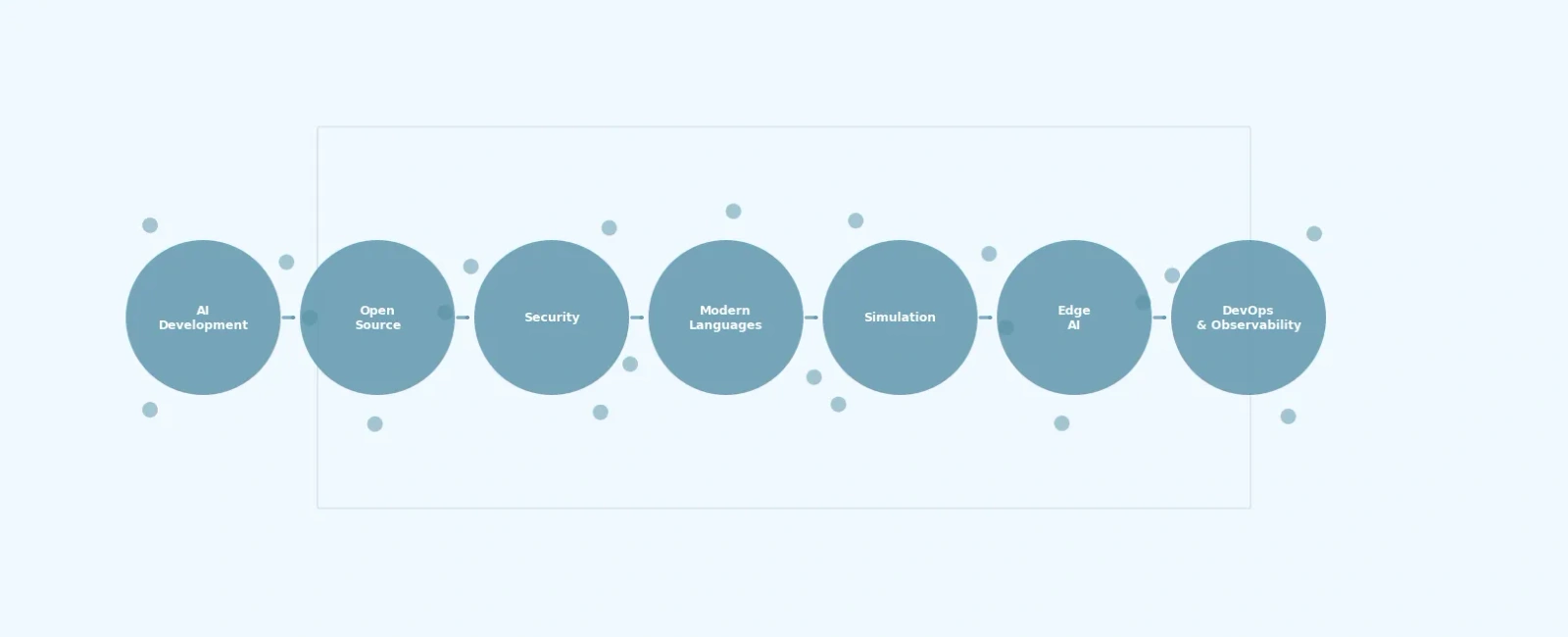
Artificial intelligence is no longer just a feature running on embedded devices—it’s becoming an integral part of the development process itself. AI-powered tools are now capable of generating, testing, and even debugging embedded code, significantly accelerating development cycles. Microsoft’s recent announcement of “AI Employees” provides a glimpse into this future, where autonomous systems handle technical tasks traditionally reserved for human developers.
These AI development tools leverage large language models trained on vast code repositories to generate optimized embedded C/C++ code, create hardware abstraction layers, and even generate device drivers based on high-level specifications. For resource-constrained embedded systems, AI can help optimize code size and performance while maintaining safety-critical requirements.
The era of proprietary embedded software is fading rapidly as open-source solutions gain widespread adoption across the industry. Projects like Zephyr RTOS, Embedded Linux, and various middleware stacks are becoming the foundation for countless embedded projects, particularly in non-safety-critical domains.
Open-source embedded solutions offer compelling advantages: unparalleled flexibility for customization, lower development costs through license-free usage, and broad community support that accelerates problem-solving. The collaborative nature of open-source development also leads to faster identification and resolution of bugs and security vulnerabilities.
With the proliferation of connected devices and increasing regulatory scrutiny, cybersecurity has moved from an afterthought to a central concern in embedded system design. In 2026, security considerations influence architectural decisions from the earliest stages of development.
Hardware-based security features are becoming standard in microcontrollers, including secure boot mechanisms, hardware cryptographic accelerators, and trusted execution environments. Software-wise, developers are implementing secure communication protocols, regular over-the-air update mechanisms, and comprehensive security monitoring capabilities.
While C has dominated embedded systems programming for decades, its limitations are driving accelerated adoption of modern alternatives. C++ and Rust are gaining significant traction in embedded development, offering improved safety features, better abstraction capabilities, and enhanced developer productivity.
C++ provides object-oriented programming capabilities, template metaprogramming for compile-time optimizations, and the Standard Template Library for reusable components. Rust, meanwhile, offers memory safety guarantees without garbage collection, making it particularly attractive for safety-critical applications where memory corruption vulnerabilities must be eliminated.
Traditional embedded development often relies heavily on hardware testing late in the development cycle, leading to tightly coupled systems and difficult-to-diagnose issues. In 2026, there’s a growing shift toward simulation-first methodologies that allow developers to validate application logic long before hardware integration.
Advanced simulation tools now accurately model microcontroller behavior, peripheral interactions, and even real-time operating system scheduling. This approach enables early detection of logical errors, performance bottlenecks, and race conditions, significantly reducing debugging time and improving overall system reliability.
While 2025 saw significant growth in AI capabilities for embedded systems, 2026 is witnessing explosive growth in the deployment of intelligence directly at the edge. Edge AI—embedding machine learning inference capabilities directly into devices rather than relying on cloud connectivity—is becoming increasingly prevalent across various applications.
This trend is driven by several factors: decreasing latency requirements for real-time applications, growing privacy concerns that favor local data processing, and bandwidth limitations in connected environments. Modern microcontrollers now include specialized hardware accelerators for neural network inference, making edge AI implementation feasible even in resource-constrained devices.
The embedded systems industry is embracing DevOps practices and enhanced observability to improve development efficiency and system reliability. Continuous integration and continuous deployment (CI/CD) pipelines are becoming standard for embedded projects, enabling automated testing and deployment of firmware updates.
Observability tools provide deep insights into system performance in real-world environments, going beyond basic logging to include distributed tracing, metrics collection, and real-time debugging capabilities. These practices help teams identify issues faster, optimize system performance, and deliver more reliable embedded solutions.
The embedded systems industry in 2026 is characterized by rapid technological evolution, increasing connectivity demands, and heightened focus on security and reliability. Developers who embrace AI-assisted development tools, leverage open-source solutions, prioritize security from the outset, adopt modern programming languages, utilize simulation-first approaches, deploy edge AI capabilities, and implement robust DevOps practices will be best positioned to succeed in this dynamic landscape.
As these trends continue to mature and intersect, we can expect to see even more innovative embedded solutions that push the boundaries of what’s possible in connected, intelligent devices.
Quick Links
Legal Stuff