

FreeRTOS Memory Pool: Zero-Copy Data Transfer
September 25, 2026
7 min
In real-time computing systems, correctness depends not merely on the logical validity of the computation, but on the exact physical instant at which the outputs are produced. When an embedded Real-Time Operating System (RTOS) task fails to complete its processing before its designated temporal boundary, a task deadline miss occurs. Unlike general-purpose computing platforms where timing delays only manifest as sluggish user interfaces, deadline misses in hard real-time embedded environments — such as automotive powertrain controllers, avionics flight actuators, medical infusion pumps, and grid protection relays — can precipitate catastrophic physical hazards, equipment destruction, or system lockouts.
Investigating and resolving deadline misses requires embedded software engineers to look beyond basic functional debugging. The root causes frequently originate from non-intuitive interactions between hardware interrupt pipelines, RTOS scheduling mechanics, memory protection boundaries, bus arbitration delays, and synchronization primitives.
This comprehensive guide analyzes the primary architectural causes of RTOS task deadline misses, examines the underlying mathematical models (including Liu & Layland utilization bounds and Response Time Analysis), explores diagnostic workflows on ARM Cortex-M targets, and details verified mitigation techniques across FreeRTOS, Zephyr, and ThreadX.
Before diagnosing timing failures, embedded architects must categorize tasks based on their temporal tolerance and arrival patterns:
+--------------------+---------------------------------------------------------+| Deadline Category | System Consequence of a Deadline Miss |+--------------------+---------------------------------------------------------+| Hard Real-Time | Total system failure, safety compromise, or physical || | damage. Utility drops to negative infinity if t > D. |+--------------------+---------------------------------------------------------+| Firm Real-Time | Result has zero utility if completed late, but isolated || | misses do not cause catastrophic system failure. || | Late output is immediately discarded (e.g., video frame)|+--------------------+---------------------------------------------------------+| Soft Real-Time | System remains functional; result utility diminishes || | progressively with completion delay (e.g., UI refresh). |+--------------------+---------------------------------------------------------+
In formal real-time scheduling theory, a periodic task tau_i is characterized by a 4-tuple:
tau_i = ( C_i, T_i, D_i, P_i )
Where:
C_i: Worst-Case Execution Time (WCET) on the target processor.T_i: Task Period (or minimum inter-arrival time for sporadic tasks).D_i: Relative Deadline measured from task release.P_i: Static or dynamic scheduling priority.Tasks are further classified by their deadline constraints:
D_i = T_i (the deadline matches the arrival of the next task period).D_i <= T_i (the task must complete strictly before its next release).D_i > T_i (multiple activations of the same task may be active concurrently).A deadline miss occurs whenever the actual response time R_i exceeds the deadline: R_i > D_i.
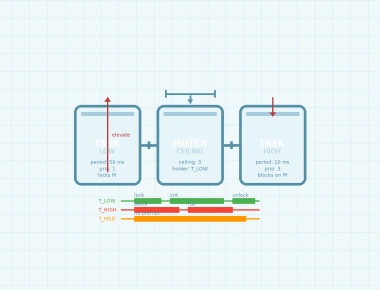
Priority inversion is one of the most hazardous timing defects in preemptive real-time systems. It occurs when a high-priority task is blocked from executing while waiting for a shared mutual exclusion resource (mutex) held by a low-priority task, and intermediate medium-priority tasks preempt the low-priority task. Because the medium-priority tasks do not require the shared resource, they run freely, indirectly blocking the high-priority task for an arbitrary duration.
+-----------------------------------------------------------------------------+| SCENARIO A: UNBOUNDED PRIORITY INVERSION |+-----------------------------------------------------------------------------+| Task Priorities: High (H) > Medium (M) > Low (L) || || Time: t0 t1 t2 t3 t4 t5 || | | | | | | || Task H: | | +---------x[Blocked on Mutex]---+ +-[Run|| | | | | | || Task M: | | | +--[Executes preempting L]-----+ || | | | | | || Task L: +--------[Holds M]-+.........+.....................+--[Rel M] || || Impact: Task M runs without needing Mutex M. Task L cannot run to release || Mutex M. Task H remains blocked indefinitely! || ===> DEADLINE MISS for Task H! |+-----------------------------------------------------------------------------+| SCENARIO B: PRIORITY INHERITANCE PROTOCOL (PIP) |+-----------------------------------------------------------------------------+| Task Priorities: High (H) > Medium (M) > Low (L) || || Time: t0 t1 t2 t3 t4 t5 || | | | | | | || Task H: | | +---------x[Blocked]--+ +-[Meets D]--->|| | | | | | || Task M: | | | (Preemption | | +-[Runs]--->|| | | | inhibited) | | | || Task L: +--------[Holds M]-+---------[Inherits H]+--[Rel M]+--+ || || Impact: Task L temporarily inherits priority H while Task H is blocked. || Task M cannot preempt Task L. Task L rapidly releases Mutex M at t4.|| Task H unblocks immediately and completes before its deadline. |+-----------------------------------------------------------------------------+
To eliminate unbounded delays, real-time operating systems implement resource synchronization protocols:
Priority Inheritance Protocol (PIP):
H blocks on a mutex held by task L, L dynamically inherits the priority of H.L resumes execution at H’s priority, preventing preemption by intermediate tasks (M).L returns to its base priority.B_i <= sum(C_crit)).Immediate Priority Ceiling Protocol (IPCP / PCP):
B_i <= max(C_crit)).A frequent bug in FreeRTOS firmware is utilizing a binary semaphore for mutual exclusion instead of a dedicated mutex. In FreeRTOS, binary semaphores created with xSemaphoreCreateBinary() have no concept of task ownership (pxMutexHolder is NULL). As a result, the kernel cannot perform priority inheritance!
/* ========================================================================== *//* ANTI-PATTERN: Binary Semaphore used for Mutual Exclusion (NO INHERITANCE) *//* ========================================================================== */// DANGEROUS: If a medium-priority task preempts the lock holder,// unbounded priority inversion occurs!SemaphoreHandle_t xBrokenLock;xBrokenLock = xSemaphoreCreateBinary();xSemaphoreGive(xBrokenLock); // Initially available/* ========================================================================== *//* CORRECT PATTERN: FreeRTOS Mutex with Native Priority Inheritance *//* ========================================================================== */SemaphoreHandle_t xSafeMutex;// Allocates TCB pointer tracking (pxMutexHolder) for priority inheritancexSafeMutex = xSemaphoreCreateMutex();void vHighPriorityTask(void *pvParameters) {for (;;) {// Blocks on mutex; triggers xTaskPriorityInherit() if held by lower taskif (xSemaphoreTake(xSafeMutex, pdMS_TO_TICKS(50)) == pdTRUE) {// Access shared hardware peripheral or shared bufferxSemaphoreGive(xSafeMutex);} else {// Handle timeout / deadline miss recovery}vTaskDelay(pdMS_TO_TICKS(10));}}
In single-address-space embedded systems without page tables, task stack frames grow toward adjacent memory regions. An undetected stack overflow does not always cause an immediate processor trap. Instead, it frequently results in latent data corruption that indirectly produces deadline misses:
TCB_t (internally tskTCB) structure of an adjacent task corrupts list item pointers (xStateListItem, xEventListItem). The scheduler subsequently gets trapped in infinite linked list loops or drops the task from the ready list.LR) or Program Counter (PC) frame causes CPU branch errors, triggering repetitive HardFault or MemManage exceptions that consume CPU cycles and starve periodic tasks.+-----------------------------------------------------------------------------+| RTOS TASK STACK LAYOUT WITH HARDWARE MPU GUARD REGION |+-----------------------------------------------------------------------------+| High Memory Address || +-------------------------------------------------------+ || | Initial Stack Allocation Boundary (Top of Stack) | || +-------------------------------------------------------+ || | Hardware Saved Context: xPSR, PC, LR, R12, R3-R0 | || | Software Saved Context: R11-R4 (FreeRTOS PendSV) | || | Task Local Variables, Arrays, & Deep Call Frames | || | | | || | | (Stack grows downwards toward low memory) | || | V | || | Current Stack Pointer (PSP) | || + - - - - - - - - - - - - - - - - - - - - - - - - - - - + || | Available Stack Headroom (Watermarked with 0xA5) | || +-------------------------------------------------------+ || | MPU Guard Region (32-Byte Subregion, NO-ACCESS) | || +-------------------------------------------------------+ <--- OVERFLOW || | Adjacent TCB / Critical Kernel Heap Memory Area | Generates || +-------------------------------------------------------+ MemManage || Low Memory Address Fault! |+-----------------------------------------------------------------------------+
On ARM Cortex-M processors, the core implements two distinct stack pointers:
While ISRs execute safely on the MSP and do not directly consume task stack space on Cortex-M, nested task function calls, heavy local structures, and standard library functions (sprintf, sscanf) can easily exhaust the PSP buffer.
FreeRTOS provides two compile-time verification methods via FreeRTOSConfig.h:
// Method 1: Checks if the current stack pointer exceeds the stack boundary// Method 2: Checks if the 20-byte 0xA5A5A5A5 watermark pattern (5 words) at// the stack end was overwritten during context switch#define configCHECK_FOR_STACK_OVERFLOW 2// User-defined hook invoked immediately upon stack corruption detectionvoid vApplicationStackOverflowHook(TaskHandle_t xTask, char *pcTaskName) {// Disable interrupts to freeze system state__disable_irq();// Log diagnostic failure to non-volatile crash bufferLOG_CRASH_INFO("STACK OVERFLOW in task: %s, Handle: %p\n", pcTaskName, xTask);// Enter safe state or trigger watchdog resetfor (;;);}// Runtime stack headroom diagnostic queryvoid vMonitorTaskHealth(TaskHandle_t xTaskHandle) {// Returns minimum unallocated stack space (in 32-bit words) since bootUBaseType_t uxHighWaterMarkWords = uxTaskGetStackHighWaterMark(xTaskHandle);uint32_t freeBytes = (uint32_t)(uxHighWaterMarkWords * sizeof(StackType_t));if (freeBytes < 64) {LOG_WARN("CRITICAL: Task %p near stack exhaustion! Free: %u bytes\n",xTaskHandle, freeBytes);}}
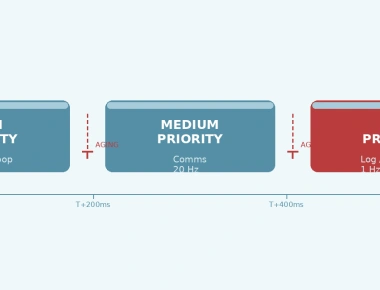
When cumulative processor utilization exceeds theoretical schedulability bounds, tasks in lower-priority tiers inevitably miss deadlines due to CPU starvation.
Processor utilization U is defined as the fraction of CPU time consumed by all periodic tasks:
nU = sum ( C_i / T_i )i=1
For a set of n independent periodic tasks with implicit deadlines (D_i = T_i) scheduled under fixed-priority Rate Monotonic Scheduling (RMS), Liu & Layland (1973) proved that a task set is guaranteed to be schedulable if:
nU = sum ( C_i / T_i ) <= n * ( 2^(1/n) - 1 )i=1Calculated Utilization Bounds:For n = 1: U_bound = 1.000 (100.0%)For n = 2: U_bound = 2 * ( 2^(1/2) - 1 ) ~= 0.828 (82.8%)For n = 3: U_bound = 3 * ( 2^(1/3) - 1 ) ~= 0.779 (77.9%)For n -> inf: lim U_bound = ln(2) ~= 0.693 (69.3%)
If total utilization is below ln(2) ~= 69.3%, all deadlines are guaranteed to be met under RMS. If utilization falls between n*(2^(1/n)-1) and 1.0, the system may or may not be schedulable.
Because the Liu & Layland test is only a sufficient condition (and assumes zero blocking time, zero interrupt interference, and D_i = T_i), modern real-time engineering uses Response Time Analysis (RTA) (Joseph & Pandya, 1986). RTA provides an exact necessary and sufficient condition.
The worst-case response time R_i of task tau_i is calculated iteratively:
R_i^(0) = C_i + B_iR_i^(k+1) = C_i + B_i + sum_{j in hp(i)} ( ceil( R_i^(k) / T_j ) * C_j )
Where:
C_i: Worst-case execution time of task tau_i.B_i: Worst-case blocking time from lower-priority tasks holding shared resources.hp(i): Set of tasks with higher priority than tau_i.ceil( R_i^(k) / T_j ) * C_j: Maximum interference generated by higher-priority task tau_j over time window R_i^(k).+-----------------------------------------------------------------------------+| RESPONSE TIME ANALYSIS (RTA): TIMING COMPONENTS FOR TASK tau_i |+-----------------------------------------------------------------------------+| || |<--------------------------- Response Time R_i --------------------------->|| || +--------------+---------------+----------------------------+---------------+| | Execution | Blocking | Preemption Interference | Context || | Time (C_i) | Time (B_i) | from Higher Priority Tasks | Switches || | | | sum( ceil(R_i/T_j) * C_j ) | (2 * N * C_sw)|| +--------------+---------------+----------------------------+---------------+| || Schedulability Test: R_i <= D_i || If R_i <= D_i, task tau_i is provably schedulable. || If R_i > D_i, task tau_i will miss deadlines during worst-case phasing! |+-----------------------------------------------------------------------------+
When context switch overhead C_sw is included, each preemption introduces two context switches (one away and one back):
R_i^(k+1) = C_i + B_i + 2 * C_sw + sum_{j in hp(i)} ( ceil( R_i^(k) / T_j ) * ( C_j + 2 * C_sw ) )
Hardware interrupt servicing sits above RTOS task scheduling in the execution hierarchy. Excessive interrupt latency and extended interrupt masking directly compromise task timing guarantees.
Interrupt latency is the duration between the hardware assert of an interrupt line and the execution of the first instruction in the corresponding ISR:
t_latency = t_hardware_stacking + t_memory_wait_states + t_critical_section_masking
t_hardware_stacking):R0-R3, R12, LR, PC, xPSR, vector fetch, and pipeline flush) completes in a deterministic 12 CPU cycles with zero-wait-state memory.S0-S15, FPSCR, and an alignment word), entry latency expands to 29+ cycles due to the additional 18-word FP frame save.t_memory_wait_states):t_critical_section_masking):BASEPRI vs. PRIMASK MaskingIn FreeRTOS on ARM Cortex-M, taskENTER_CRITICAL() does not execute CPSID i (which sets PRIMASK and masks all configurable interrupts). Instead, it modifies the BASEPRI register:
+--------------------+---------------------------------------------------------+| Priority Level | Interrupt Handling Behavior in FreeRTOS |+--------------------+---------------------------------------------------------+| Numerically Lower | "Zero-Latency" Interrupts. Higher priority than || than configMAX_ | configMAX_SYSCALL_INTERRUPT_PRIORITY. Never masked by || SYSCALL_INTERRUPT_ | kernel critical sections. CANNOT call any FreeRTOS API. || PRIORITY | |+--------------------+---------------------------------------------------------+| Numerically Higher | RTOS-Managed Interrupts. Masked during kernel critical || than or equal to | sections via BASEPRI. Permitted to call FreeRTOS || configMAX_SYSCALL | API functions ending with ...FromISR(). |+--------------------+---------------------------------------------------------+
// Incorrect ISR priority configuration leading to system lockups:// If an ISR with numerical priority < configMAX_SYSCALL_INTERRUPT_PRIORITY// calls a FreeRTOS API, RTOS internal state lists are corrupted!#define configLIBRARY_MAX_SYSCALL_INTERRUPT_PRIORITY 5// Valid ISR configuration in CMSIS:NVIC_SetPriority(USART1_IRQn, NVIC_EncodePriority(NVIC_GetPriorityGrouping(), 6, 0));
Lengthy computations inside ISRs delay both lower-priority interrupts and all RTOS tasks. Best practice mandates deferring work to tasks or kernel workqueues.
Below is an implementation of deferred interrupt handling in Zephyr RTOS:
#include <zephyr/kernel.h>#include <zephyr/drivers/gpio.h>#define WORK_QUEUE_STACK_SIZE 1024#define WORK_QUEUE_PRIORITY 4K_THREAD_STACK_DEFINE(worker_stack, WORK_QUEUE_STACK_SIZE);struct k_work_q worker_work_q;struct k_work isr_deferred_work;// Bottom-half handler: Executes in task context with preemption enabledvoid isr_deferred_handler(struct k_work *item) {// Process incoming UART/SPI buffer, compute sensor filters, etc.// Heavy execution happens here without starving high-priority ISRs}// Top-half ISR: Fast and deterministic (< 2 microseconds)void gpio_input_isr(const struct device *dev, struct gpio_callback *cb, uint32_t pins) {// 1. Acknowledge hardware interrupt register// 2. Offload processing to dedicated RTOS work queuek_work_submit_to_queue(&worker_work_q, &isr_deferred_work);}void init_subsystem(void) {k_work_queue_init(&worker_work_q);k_work_queue_start(&worker_work_q, worker_stack,K_THREAD_STACK_SIZEOF(worker_stack),WORK_QUEUE_PRIORITY, NULL);k_work_init(&isr_deferred_work, isr_deferred_handler);}
Pinpointing the exact mechanism behind a deadline miss requires hardware-assisted instrumentation and kernel profiling:
The Data Watchpoint and Trace (DWT) block includes a 32-bit cycle counter (CYCCNT) running at the core CPU frequency. It enables sub-microsecond timing measurement with near-zero overhead:
#include "core_cm4.h"static inline void dwt_cycle_counter_init(void) {// Enable TRCENA bit in CoreDebug DEMCR registerCoreDebug->DEMCR |= CoreDebug_DEMCR_TRCENA_Msk;// Reset cycle counter registerDWT->CYCCNT = 0;// Enable DWT cycle counterDWT->CTRL |= DWT_CTRL_CYCCNTENA_Msk;}static inline uint32_t dwt_get_cycles(void) {return DWT->CYCCNT;}void vMeasuredTaskFunction(void *pvParameters) {dwt_cycle_counter_init();for (;;) {uint32_t start_cycles = dwt_get_cycles();// Target task workload under diagnostic evaluationvExecuteCriticalControlAlgorithm();uint32_t elapsed_cycles = dwt_get_cycles() - start_cycles;// Convert to microseconds: (elapsed_cycles * 1000000) / SystemCoreClockuint32_t elapsed_us = (uint32_t)(((uint64_t)elapsed_cycles * 1000000ULL) / SystemCoreClock);if (elapsed_us > 1500) { // Schedulability threshold: 1.5 msLOG_ERROR("WCET VIOLATION: Execution reached %u us!\n", elapsed_us);}vTaskDelay(pdMS_TO_TICKS(10));}}
Kernel event tracing is essential for uncovering synchronization deadlocks and task preemption chains:
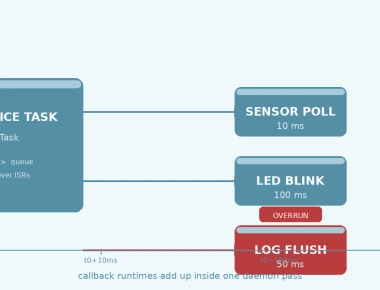
Trace visualizers make priority inversion immediately obvious: a high-priority task will be displayed in the Blocked state while a low-priority task holds the mutex and a medium-priority task monopolizes the CPU.
An industrial condition-monitoring sensor node runs on an STM32H7 (ARM Cortex-M7 running at 480 MHz) using FreeRTOS. The system executes three tasks:
+-----------------------+----------+---------+----------+----------+| Task Name | Period T | WCET C | Deadline | Priority |+-----------------------+----------+---------+----------+----------+| Task 1: IMU Sampling | 1.0 ms | 0.20 ms | 1.0 ms | High (5) || Task 2: Modbus Comms | 10.0 ms | 2.50 ms | 10.0 ms | Med (3) || Task 3: Flash Storage | 100.0 ms | 18.0 ms | 100.0 ms | Low (1) |+-----------------------+----------+---------+----------+----------+
Total processor utilization:
U = (0.2 / 1.0) + (2.5 / 10.0) + (18.0 / 100.0) = 0.20 + 0.25 + 0.18 = 0.63 (63%)
Theoretical utilization U = 63% is comfortably below the Liu & Layland bound (n=3 -> 77.9%). However, in production testing, Task 1 (IMU Sampling) suffered sporadic deadline misses every 4 to 8 seconds, resulting in missing vibration frames.
SEGGER SystemView trace analysis revealed two critical design defects:
Unbounded Inversion via Binary Semaphore:
Task 1 and Task 3 shared an SPI bus protected by a binary semaphore (xSemaphoreCreateBinary()).Task 3 (Flash Storage) acquired the lock and began erasing a flash sector (duration: ~15 ms).Task 2 (Modbus Comms) received an incoming frame, preempted Task 3, and ran for 2.5 ms.Task 1 was released, attempted to take the SPI semaphore, and blocked.Task 3 remained at Priority 1. Task 2 continued executing, while Task 3 was starved from finishing its critical section.Task 1: 15.0 ms + 2.5 ms = 17.5 ms, severely exceeding its 1.0 ms deadline!ISR Starvation via UART Overrun:
configMAX_SYSCALL_INTERRUPT_PRIORITY), but performed CRC verification byte-by-byte inside the ISR loop, stalling the CPU for up to 350 microseconds.Eliminated Semaphore Contention with Lock-Free SPSC Ring Buffers:
Task 1. Instead, Task 1 writes sampled IMU data into a lock-free Single-Producer Single-Consumer (SPSC) circular queue in fast DTCM RAM (Data Tightly-Coupled Memory, 0-wait-state).Task 3 reads batches from the ring buffer and writes to Flash independently.Replaced Shared Lock with Priority Inheritance Mutex:
xSemaphoreCreateMutex().Offloaded UART ISR to DMA:
Applying Response Time Analysis after the fixes:
B_1 for Task 1 dropped from 17.5 ms to 0.0 ms (no shared locks).R_1 = C_1 = 0.20 ms <= 1.0 ms (Meets deadline).R_2^(0) = C_2 = 2.50 msR_2^(1) = C_2 + ceil(2.50 / 1.0) * C_1 = 2.50 + 3 * (0.20) = 3.10 msR_2^(2) = 2.50 + ceil(3.10 / 1.0) * 0.20 = 2.50 + 4 * (0.20) = 3.30 msR_2^(3) = 2.50 + ceil(3.30 / 1.0) * 0.20 = 3.30 ms (Converged)R_2 = 3.30 ms <= 10.0 ms (Meets deadline).
In subsequent 72-hour thermal chamber stress tests, zero deadline misses were observed.
+-----------------------+------------------------------------------------------+| Design Phase | Verification Activity |+-----------------------+------------------------------------------------------+| Architecture | - Perform utilization bound calculation (U < ln(2)). || | - Formulate exact Response Time Analysis (RTA) with || | blocking times B_i and context switch costs C_sw. || | - Ensure all periodic deadlines satisfy R_i <= D_i. |+-----------------------+------------------------------------------------------+| Synchronization | - Never use binary semaphores for mutual exclusion. || | - Use xSemaphoreCreateMutex() or Priority Ceiling || | Protocol (IPCP) to eliminate unbounded inversion. || | - Isolate shared buses using lock-free SPSC queues. |+-----------------------+------------------------------------------------------+| Memory Protection | - Enable RTOS stack watermarking (Method 2). || | - Configure hardware MPU stack guard subregions. || | - Audit worst-case call graph depth via compiler || | flags (-fstack-usage, -Wstack-usage). |+-----------------------+------------------------------------------------------+| Interrupt Subsystem | - Keep all ISR handlers under 10 microseconds. || | - Offload bottom-half processing to worker threads. || | - Verify NVIC priority grouping and BASEPRI masking. || | - Offload high-bandwidth peripherals to DMA. |+-----------------------+------------------------------------------------------+
Quick Links
Legal Stuff