

Fixing UART Overrun Errors on NXP i.MX RT with FlexIO
October 13, 2026
5 min
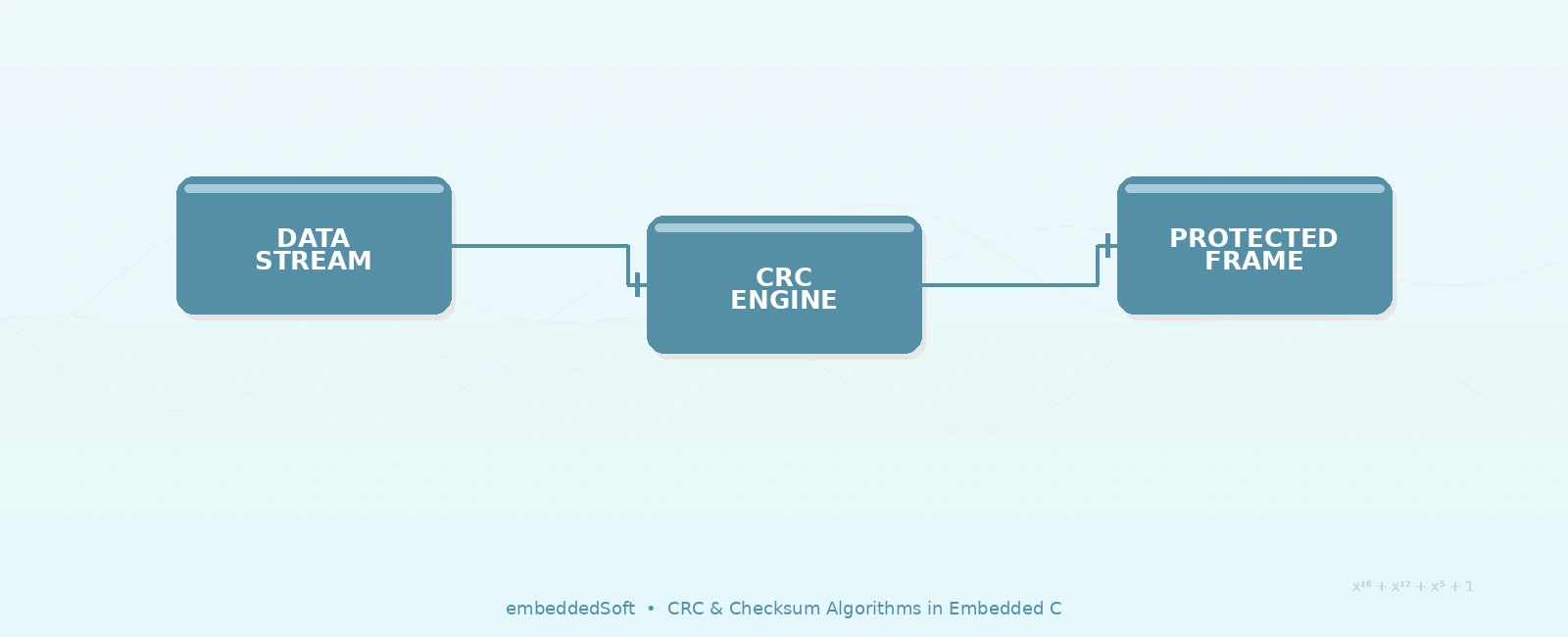
Error detection is a fundamental requirement of robust embedded communication protocols. From UART frames to CAN bus messages, from SPI flash reads to Over-The-Air (OTA) firmware updates, uncorrected bit flips can cascade into critical system failures. Despite its importance, CRC implementation is frequently treated as a black box—often resulting in the blind integration of unverified polynomials and lookup tables without a rigorous understanding of the underlying mathematics.
This article dissects the mathematics behind error detection, compares algorithmic approaches, and provides production-ready C implementations optimized for resource-constrained targets.
Error detection codes add redundancy to data so the receiver can detect corruption. The fundamental tradeoff is between detection capability and overhead (compute cycles, code size, bandwidth).
The simplest approach treats data as a sequence of integers and computes a summary value.
// Internet checksum (RFC 1071) - 16-bit ones' complement sumuint16_t internet_checksum(const uint8_t *data, size_t len) {uint32_t sum = 0;size_t i = 0;// Process 16-bit wordswhile (len > 1) {sum += ((uint32_t)data[i] << 8) | data[i + 1];i += 2;len -= 2;}// Handle odd byteif (len == 1) {sum += (uint32_t)data[i] << 8;}// Fold carry bits back into lower 16 bitswhile (sum >> 16) {sum = (sum & 0xFFFF) + (sum >> 16);}return (uint16_t)~sum; // Ones' complement}
Strengths: Extremely fast, minimal code size, hardware-friendly. Weaknesses: Misses many error patterns (bit transpositions, compensated errors). Unsuitable for safety-critical links.
Cyclic Redundancy Check treats the message as a polynomial over GF(2) (coefficients 0 or 1, addition = XOR). The transmitter divides the message polynomial by a generator polynomial G(x) and appends the remainder. The receiver divides the received polynomial by G(x) — a zero remainder means no detected errors.
Message: 1101 (4 bits)Append 0s: 11010000 (append degree(G) zeros, 4 zeros)Divide by: 10011 (G(x) = x^4 + x + 1, degree 4)Remainder: 0100 (4-bit CRC)Transmitted: 11010100
The generator polynomial choice determines error detection properties. Standard polynomials are irreducible over GF(2) and have specific bit patterns.
// Standard CRC polynomials (reflected/reversed representation for bitwise algorithm)#define CRC16_CCITT_POLY 0x8408 // x^16 + x^12 + x^5 + 1 (reflected 0x1021)#define CRC16_IBM_POLY 0xA001 // x^16 + x^15 + x^2 + 1 (reflected 0x8005)#define CRC32_POLY 0xEDB88320 // Reflected 0x04C11DB7
Why reflected polynomials? Bit-serial CRC processes LSB first (natural for UART shift registers). The reflected polynomial produces the same remainder as the non-reflected version when bits are processed in reverse order.
+------------------------+------------+-------------+--------------+------------------+| Algorithm | Detects | Code Size | Cycles/Byte | Best For |+------------------------+------------+-------------+--------------+------------------+| 8-bit sum | Single-bit | ~50 bytes | 2-3 | Quick sanity || 16-bit Internet cksum | Many 16-bit| ~80 bytes | 3-4 | IP/UDP/TCP || CRC-8 (0x07) | Good burst | ~100 bytes | 8-12 | 1-Wire, SMBus || CRC-16-CCITT (table) | Excellent | ~600 bytes | 4-5 | XModem, Bluetooth|| CRC-32 (table) | Near-perf | ~1.5 KB | 4-5 | Ethernet, ZIP || CRC-32 (slice-by-8) | Near-perf | ~8 KB | 1-2 | High-throughput |+------------------------+------------+-------------+--------------+------------------+
Table-driven CRC processes one byte per loop iteration with a single table lookup and XOR — optimal for software on byte-addressable architectures.
#include <stdint.h>#include <stddef.h>/* CRC-16-CCITT (XModem) polynomial: 0x1021, initial: 0x0000, no reflection, no final XOR *//* Reflected polynomial for bitwise LSB-first: 0x8408 */static const uint16_t crc16_ccitt_table[256] = {0x0000, 0x1021, 0x2042, 0x3063, 0x4084, 0x50A5, 0x60C6, 0x70E7,0x8108, 0x9129, 0xA14A, 0xB16B, 0xC18C, 0xD1AD, 0xE1CE, 0xF1EF,0x1231, 0x0210, 0x3273, 0x2252, 0x52B5, 0x4294, 0x72F7, 0x62D6,0x9339, 0x8318, 0xB37B, 0xA35A, 0xD3BD, 0xC39C, 0xF3FF, 0xE3DE,/* ... 216 more entries generated by polynomial 0x1021 ... */0x6E17, 0x7E36, 0x4E55, 0x5E74, 0x2E93, 0x3EB2, 0x0ED1, 0x1EF0};uint16_t crc16_ccitt(const uint8_t *data, size_t length, uint16_t init) {uint16_t crc = init;for (size_t i = 0; i < length; i++) {crc = (crc << 8) ^ crc16_ccitt_table[((crc >> 8) ^ data[i]) & 0xFF];}return crc;}/* Usage for XModem (initial 0x0000) */uint16_t crc16_xmodem(const uint8_t *data, size_t length) {return crc16_ccitt(data, length, 0x0000);}/* Usage for CCITT-FALSE (initial 0xFFFF) */uint16_t crc16_ccitt_false(const uint8_t *data, size_t length) {return crc16_ccitt(data, length, 0xFFFF);}
Lookup tables should not be manually copied from unverified sources. Instead, they should be generated dynamically within the build system to mathematically guarantee correctness:
# gen_crc_table.pydef generate_crc16_table(poly=0x1021, reflect=False):table = []if reflect:# Reflect polynomial for 16-bit LSB-firstpoly_use = 0for i in range(16):if (poly >> i) & 1:poly_use |= 1 << (15 - i)else:poly_use = polyfor i in range(256):if reflect:crc = ifor _ in range(8):crc = (crc >> 1) ^ poly_use if (crc & 1) else (crc >> 1)else:crc = i << 8for _ in range(8):crc = ((crc << 1) ^ poly_use) if (crc & 0x8000) else (crc << 1)crc &= 0xFFFFtable.append(crc & 0xFFFF)return table# CMake integration:# add_custom_command(# OUTPUT ${CMAKE_CURRENT_BINARY_DIR}/crc16_table.h# COMMAND python3 ${CMAKE_CURRENT_SOURCE_DIR}/gen_crc_table.py# > ${CMAKE_CURRENT_BINARY_DIR}/crc16_table.h# DEPENDS ${CMAKE_CURRENT_SOURCE_DIR}/gen_crc_table.py# )
// Generated crc16_table.hstatic const uint16_t crc16_ccitt_table[256] = {0x0000, 0x1021, 0x2042, 0x3063, 0x4084, 0x50A5, 0x60C6, 0x70E7,0x8108, 0x9129, 0xA14A, 0xB16B, 0xC18C, 0xD1AD, 0xE1CE, 0xF1EF,0x1231, 0x0210, 0x3273, 0x2252, 0x52B5, 0x4294, 0x72F7, 0x62D6,0x9339, 0x8318, 0xB37B, 0xA35A, 0xD3BD, 0xC39C, 0xF3FF, 0xE3DE,// ... remaining 224 entries};
Ethernet, ZIP, PNG, and many storage formats use CRC-32 (polynomial 0x04C11DB7). For high-speed links, slice-by-8 (or slice-by-4/16) processes multiple bytes per iteration using multiple lookup tables.
// CRC-32 slice-by-4: 4 tables, 4KB total, ~1.5 cycles/byte on Cortex-M4static uint32_t crc32_table[4][256];void crc32_init_sliceby4(void) {const uint32_t poly = 0xEDB88320; // Reflected 0x04C11DB7for (int i = 0; i < 256; i++) {uint32_t crc = i;for (int j = 0; j < 8; j++) {crc = (crc >> 1) ^ (poly & -(crc & 1));}crc32_table[0][i] = crc;}// Build tables 1-3 by shifting table 0 (LSB-first / reflected)for (int i = 0; i < 256; i++) {uint32_t c = crc32_table[0][i];crc32_table[1][i] = crc32_table[0][c & 0xFF] ^ (c >> 8);c = crc32_table[1][i];crc32_table[2][i] = crc32_table[0][c & 0xFF] ^ (c >> 8);c = crc32_table[2][i];crc32_table[3][i] = crc32_table[0][c & 0xFF] ^ (c >> 8);}}uint32_t crc32_sliceby4(const uint8_t *data, size_t len, uint32_t crc) {crc = ~crc;while (len >= 4) {// Safe read to prevent strict-aliasing, alignment faults, and host-endianness bugsuint32_t word = (uint32_t)data[0] |((uint32_t)data[1] << 8) |((uint32_t)data[2] << 16) |((uint32_t)data[3] << 24);crc ^= word;crc = crc32_table[3][crc & 0xFF] ^crc32_table[2][(crc >> 8) & 0xFF] ^crc32_table[1][(crc >> 16) & 0xFF] ^crc32_table[0][(crc >> 24) & 0xFF];data += 4;len -= 4;}while (len--) {crc = crc32_table[0][(crc ^ *data++) & 0xFF] ^ (crc >> 8);}return ~crc;}
Memory vs. Speed Trade-off:
| Variant | Tables | Table Size | Cycles/Byte (Cortex-M4) |
|---|---|---|---|
| Byte-wise | 1 | 1 KB | ~4.5 |
| Slice-by-4 | 4 | 4 KB | ~1.8 |
| Slice-by-8 | 8 | 8 KB | ~1.2 |
| Slice-by-16 | 16 | 16 KB | ~0.9 |
For most embedded targets, slice-by-4 hits the sweet spot.
Modern MCUs include CRC computation units. STM32 example:
// STM32H7 CRC peripheral (polynomial configurable)uint32_t crc32_hardware(const uint8_t *data, size_t len) {RCC->AHB4ENR |= RCC_AHB4ENR_CRCEN; // STM32H7 uses AHB4 for CRC// Configure hardware for bit-reversal (required for Ethernet CRC-32)CRC->CR = CRC_CR_RESET | CRC_CR_REV_IN | CRC_CR_REV_OUT;CRC->INIT = 0xFFFFFFFF; // Initial valueCRC->POL = 0x04C11DB7; // Polynomial// Process 32-bit words (hardware handles bit reflection)size_t word_count = len / 4;for (size_t i = 0; i < word_count; i++) {uint32_t word = (uint32_t)data[i * 4] |((uint32_t)data[i * 4 + 1] << 8) |((uint32_t)data[i * 4 + 2] << 16) |((uint32_t)data[i * 4 + 3] << 24);CRC->DR = word;}// Handle remaining bytesfor (size_t i = word_count * 4; i < len; i++) {*(volatile uint8_t *)&CRC->DR = data[i];}return ~CRC->DR;}
Hardware CRC Caveats:
Modbus RTU uses CRC-16-IBM (polynomial 0x8005, initial 0xFFFF, reflected).
// Modbus RTU frame: [Slave ID][Function Code][Data...][CRC Lo][CRC Hi]bool modbus_rtu_verify(const uint8_t *frame, size_t len) {if (len < 4) return false; // Min: ID + FC + 2-byte CRCuint16_t received_crc = (uint16_t)frame[len - 2] | ((uint16_t)frame[len - 1] << 8);uint16_t calc_crc = crc16_ibm(frame, len - 2, 0xFFFF);return received_crc == calc_crc;}void modbus_rtu_append_crc(uint8_t *frame, size_t *len) {uint16_t crc = crc16_ibm(frame, *len, 0xFFFF);frame[(*len)++] = crc & 0xFF; // Low byte first (little-endian)frame[(*len)++] = (crc >> 8) & 0xFF;}
+--------+--------+----------------+--------+--------+| Slave | Func | Data (N bytes) | CRC Lo | CRC Hi || ID | Code | | | |+--------+--------+----------------+--------+--------+1 byte 1 byte N bytes 1 byte 1 byte(LSB) (MSB)Transmission order: Slave ID -> Func Code -> Data[0]...Data[N-1] -> CRC Lo -> CRC HiCRC calculation covers: Slave ID + Func Code + Data[0]...Data[N-1]Polynomial: 0x8005 (x^16 + x^15 + x^2 + 1), reflected: 0xA001Initial value: 0xFFFF, Final XOR: 0x0000, Reflected in/out: Yes
| Representation | CRC-16-CCITT | CRC-16-IBM | CRC-32 |
|---|---|---|---|
| Normal (MSB-first) | 0x1021 | 0x8005 | 0x04C11DB7 |
| Reflected (LSB-first) | 0x8408 | 0xA001 | 0xEDB88320 |
| Reciprocal (Koopman) | 0x8810 | 0xC002 | 0x82608EDB |
Rule: Match the polynomial representation to your algorithm’s shift direction.
crc >> 1 or crc >> 8).crc << 1 or crc << 8).// Kermit: init=0x0000, xorout=0x0000, reflect in/out// CCITT-FALSE: init=0xFFFF, xorout=0x0000, NO reflection// XModem: init=0x0000, xorout=0x0000, NO reflection// Modbus: init=0xFFFF, xorout=0x0000, reflect in/out
Implementations must always be verified against known standard test vectors:
// CRC-16-CCITT (XModem) test vector: "123456789" -> 0x31C3uint8_t test_data[] = "123456789";uint16_t result = crc16_xmodem(test_data, 9);assert(result == 0x31C3); // Fails if reflection/init/xor wrong
CRC-16 is transmitted LSB-first (little-endian) for Modbus, but MSB-first for many other protocols. This must be documented explicitly in any protocol specification:
// Modbus RTU: CRC transmitted LOW byte firstframe[len++] = crc & 0xFF;frame[len++] = crc >> 8;// Some protocols (e.g., CRC-32 in PNG): MSB firstframe[len++] = crc >> 24;frame[len++] = crc >> 16;frame[len++] = crc >> 8;frame[len++] = crc & 0xFF;
Polynomial: x^4 + x + 1 (Drops x^4 for 4-bit register -> XOR with 0011)Message: 1101 (append 4 zeros) -> 11010000Process: Shift left, bringing in message bits at the right. If MSB shifted out is 1, XOR with 0011.Step 1: Input bit '1' -> Shift out '0'Register: [0][0][0][1]Step 2: Input bit '1' -> Shift out '0'Register: [0][0][1][1]Step 3: Input bit '0' -> Shift out '0'Register: [0][1][1][0]Step 4: Input bit '1' -> Shift out '0'Register: [1][1][0][1]Step 5: Input bit '0' -> Shift out '1' (MSB was 1!)Shifted: [1][0][1][0]XOR poly: [0][0][1][1]Result: [1][0][0][1]Step 6: Input bit '0' -> Shift out '1' (MSB was 1!)Shifted: [0][0][1][0]XOR poly: [0][0][1][1]Result: [0][0][0][1]Step 7: Input bit '0' -> Shift out '0'Register: [0][0][1][0]Step 8: Input bit '0' -> Shift out '0'Register: [0][1][0][0]Final register holds the 4-bit CRC: 0100 (0x4)Transmitted: 1101 + 0100 -> 11010100
Error detection is not optional in embedded systems — it is the critical distinction between a detected communication fault and silent data corruption. CRC provides mathematically proven detection capabilities that are fundamentally superior to simple arithmetic checksums. Key conclusions:
Quick Links
Legal Stuff