

A/B vs In-Place Firmware Updates: Trade-offs for Embedded Systems
August 03, 2026
4 min
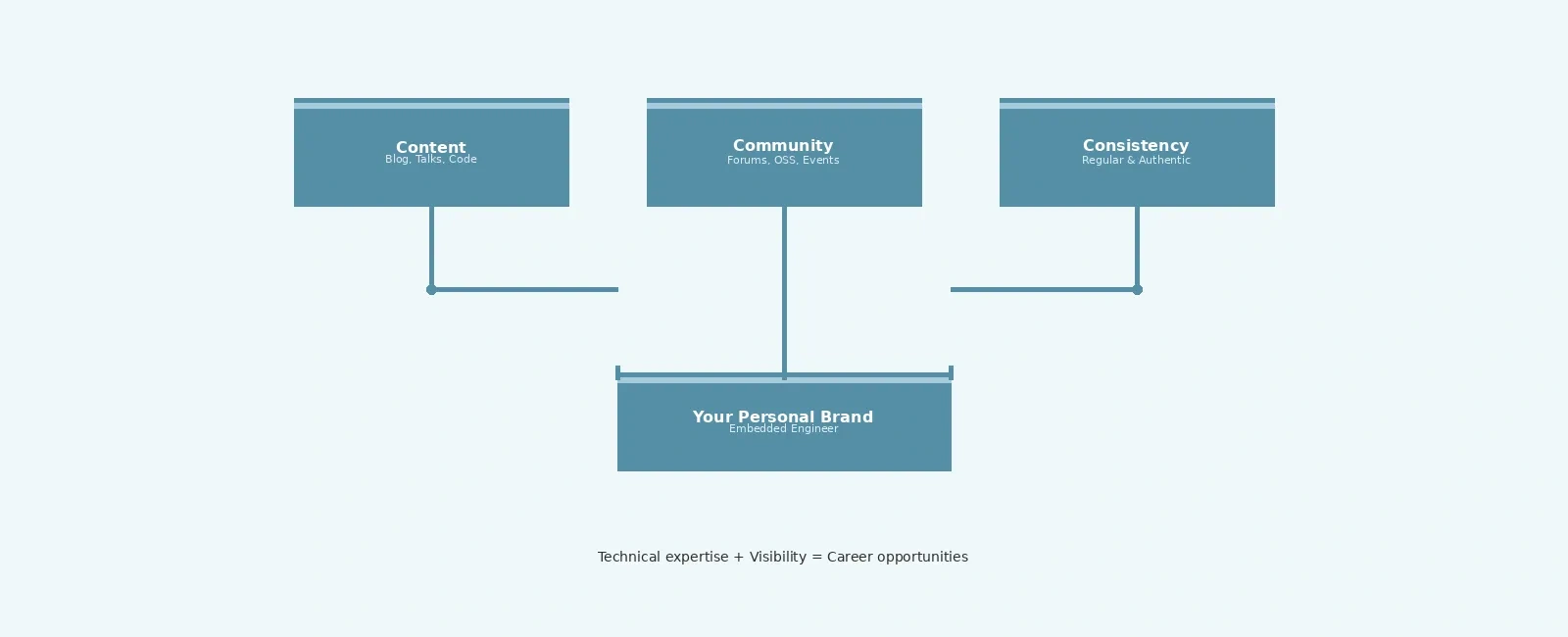
In a specialized technical domain, building a personal brand as an embedded engineer is often the difference between a plateaued career and professional autonomy. While application developers enjoy immediate visibility on consumer screens, the achievements of a firmware developer or hardware systems engineer are typically sealed away inside physical enclosures, operating silently in silicon. This isolation creates a distinct professional paradox: the closer your work sits to the bare metal, the more invisible it is to the broader industry. At the mid-to-senior level, technical competence alone is no longer enough to secure the most rewarding roles; establishing a visible professional presence and demonstrating thought leadership is the primary lever for career growth and long-term agency.
For an experienced systems practitioner, the concept of a personal brand often carries a distasteful connotation, bringing to mind superficial self-promotion, transactional networking, or high-frequency social media activity. However, authentic professional branding for senior engineers is not about becoming an influencer. It is about documenting hard-earned technical wisdom in a way that others can reference, trust, and build upon.
At a senior level, your professional brand is the record of how you think, how you architect systems, and how you solve complex engineering problems. It is the persistent artifact of your intellectual contribution to the field of embedded hardware and software.
Why does professional visibility matter when you are already a competent senior engineer? In a highly specialized niche like embedded systems engineering, a silent career is often a vulnerable one. If your technical reputation exists only within the walls of your current employer, your career growth is strictly bounded by their immediate trajectory. A visible professional presence acts as a signal amplifier, attracting opportunities rather than requiring you to actively search for them.
It shifts your standing from a transactional resource to a trusted advisor. When organizations face critical system design challenges, they do not look for a generic list of skills on a resume. They seek out the individual who has written the authoritative analysis on that exact class of problems, whether that involves real-time scheduling latency or power optimization strategies.
The most common objection raised by senior embedded engineers is that their most significant achievements are proprietary. They operate under non-disclosure agreements, building software for commercial products that cannot be shared or open-sourced.
However, sharing expertise does not require disclosing proprietary code. True technical authority lies in explaining the underlying patterns, the trade-offs, and the debugging methodologies. One can discuss the theoretical aspects of real-time scheduling jitter, memory allocation strategies in safety-critical applications, or noise mitigation techniques on communication buses without ever mentioning a specific project, vendor, or proprietary design. By abstracting the problem, you make the lesson universal, which is far more valuable to the engineering community than a narrow, product-specific code snippet.
Building professional authority is a slow-burn process that mirrors the compounding nature of technical debt—but in reverse. Early efforts may yield quiet responses, but a persistent accumulation of high-quality, thoughtful reflections builds a resilient foundation. This is not about writing basic tutorials or high-frequency updates. It is about maintaining a consistent repository of design decisions, architecture post-mortems, and reflections on system design.
Over time, these writings become a professional portfolio that speaks for you, establishing your credibility before you ever walk into a room.
For the senior systems engineer, personal branding is not an exercise in vanity, but an act of professional self-determination. It is the conscious decision to step out from behind the silicon and own the narrative of your expertise. By translating your practical experience into public, accessible knowledge, you contribute to the engineering ecosystem while ensuring that your career remains as robust and resilient as the systems you design.
Quick Links
Legal Stuff