

Automating Firmware Release Pipelines with GitHub Actions
August 23, 2026
2 min
Flaky CI pipelines waste engineering hours, erode trust in automation, and delay releases. In embedded firmware, flakiness is amplified by hardware dependencies, timing constraints, and environmental differences between local development and CI runners. This article dissects the root causes, shows how to systematically detect flaky tests, and provides battle-tested stabilization patterns for GitHub Actions.
Embedded firmware CI fails in ways pure software CI does not. A test that passes 99 times locally may fail on the 100th run in CI because:
The search query engineers type at 2 AM: “GitHub Actions embedded tests flaky”, “firmware CI intermittent failures”, “hardware-in-the-loop test unreliable”.
Before fixing, classify each flaky failure into one of five categories. This taxonomy drives the remediation strategy.
+----------------------------------------------------------------------+| FLAKY FAILURE TAXONOMY |+-------------------+---------------------------------+----------------+| CLASS | SYMPTOMS | FIX PATH |+-------------------+---------------------------------+----------------+| TIMING SENSITIVE | Random timeouts, race cond., | Mocks, bounded || | scheduling jitter | timeout loops |+-------------------+---------------------------------+----------------+| HARDWARE STATE | USB claim fails, GPIO stuck, | Host runner || LEAKAGE | stale flash sector | cleanup hook |+-------------------+---------------------------------+----------------+| HIL ENVIRONMENT | Probe disconnect, power dip, | Dedicated HIL || NOISE | cable/connector jitter | queue + retry |+-------------------+---------------------------------+----------------+| TOOLCHAIN | Binary differs, link address | Reproducible || NON-DETERMINISM | shifts across runner VMs | build pipeline |+-------------------+---------------------------------+----------------+| RESOURCE | "Port busy", "Target lost", | Serialized pool|| CONTENTION | parallel debug job collisions | or concurrency |+-------------------+---------------------------------+----------------+
A test is formally classified as flaky when it yields non-deterministic outcomes across identical Git commits without code or toolchain modifications. The metric governing flakiness severity is defined as:
N_inconsistent_runsFlake Rate (%) = --------------------- * 100N_total_executions
Timing-sensitive flakiness is the most insidious category because it masquerades as genuine race conditions in the production code. The failure manifests as intermittent assertion violations on cycle counts, interrupt latencies, or RTOS scheduling boundaries. The root cause is almost always environmental: CI runner load shifts thread scheduling, thermal throttling changes CPU frequency, or container noise introduces microsecond-scale jitter.
Consider a test verifying that an ISR completes within 15 microseconds. On a bare-metal development board, this passes consistently. In a GitHub Actions Ubuntu runner sharing a physical host with other jobs, the same test fails when a noisy neighbor triggers CPU frequency scaling. The fix is not to relax the timing requirement — that masks real regressions. Instead, decouple the timing measurement from the test assertion. Mock the timer peripheral in unit tests, and gate hardware-verified timing tests behind a separate HIL pipeline with dedicated runners.
GitHub Actions hosted runners reuse VM instances across workflow runs. A test that opens /dev/ttyACM0 to communicate with an STM32 via USB and crashes mid-execution leaves the device claimed. The subsequent workflow run fails with “Resource temporarily unavailable” — a classic flaky signal that has nothing to do with the code under test.
The remediation requires three layers: runner-level cleanup in always() blocks, test-process-level resource tracking, and CI-level isolation. The runner cleanup resets USB subsystem state and kills stray debug probe processes. The test framework tracks every opened resource and ensures deterministic teardown. The CI configuration uses concurrency groups to serialize hardware-dependent jobs.
Hardware-in-the-loop setups introduce physical-world variability that pure software CI never encounters. A probe disconnects because a cable shifted. The target board browns out because the USB power delivery negotiated 500mA but the test draws 800mA during flash programming. The JTAG adapter enters an undefined state because the previous test left the TAP controller in an unexpected state.
These failures are not code bugs — they are infrastructure reliability problems. The solution is a dedicated HIL queue with mandatory health checks before each test run, automatic retry with full hardware reset between attempts, and physical infrastructure monitoring (probe connection status, target power rail voltage, environmental temperature).
A test passes on Monday and fails on Tuesday with no code changes. The binary size differs by 12 bytes. The linker placed a critical section at a different address. The compiler emitted a different instruction sequence for the same source due to a minor version bump in the hosted runner’s toolchain.
Non-reproducible builds are a silent flakiness amplifier. The fix is enforcing reproducible builds: strip build timestamps, normalize debug prefix maps, pin exact toolchain versions in CI, and verify binary equivalence across clean builds as a CI gate.
Parallel test jobs compete for scarce physical resources: USB ports, JTAG adapters, target boards, license servers for proprietary tools. Job A claims the only J-Link; Job B times out waiting. Job C starts flashing while Job D is mid-debug-session. The failure is non-deterministic because it depends on scheduler whims.
The fix is a resource pool with explicit acquisition and release semantics, integrated with GitHub Actions concurrency controls. Each job acquires a lease before touching hardware, the lease has a timeout, and the always() block guarantees release even on cancellation.
You cannot fix what you cannot measure. Implement a three-layer detection strategy.
In embedded firmware CI, host-based test harnesses (compiled via CMake/Ninja using Ceedling, Unity, or GoogleTest) should emit standard JUnit XML. CMake/CTest natively produces JUnit XML via the --output-junit flag. GitHub Actions can then parse this XML to surface annotations, highlight timing outliers, and track flaky executions without external SaaS dependencies.
# .github/workflows/test.ymlname: Embedded Firmware Host Testson:push:branches: [main, develop]pull_request:jobs:host-unit-tests:runs-on: ubuntu-lateststeps:- uses: actions/checkout@v4- name: Install Toolchain and Test Dependenciesrun: |sudo apt-get updatesudo apt-get install -y cmake ninja-build gcc-multilib- name: Configure CMake Host Buildrun: |cmake -B build -G Ninja \-DCMAKE_BUILD_TYPE=Debug \-DBUILD_TESTING=ON \-DENABLE_MOCK_DRIVERS=ON- name: Compile Unit Testsrun: cmake --build build- name: Execute CTest with JUnit Reportingrun: |# CTest natively exports structured JUnit XML for all executed test suitesctest --test-dir build --output-on-failure --output-junit ctest-report.xml- name: Publish Test Annotationsuses: dorny/test-reporter@v1if: always()with:name: Firmware Unit Test Reportpath: ctest-report.xmlreporter: java-junitfail-on-error: true- name: Upload Test Report Artifactuses: actions/upload-artifact@v4if: always()with:name: junit-test-resultspath: ctest-report.xml
Intermittent race conditions and subtle memory corruption often pass on single runs. Schedule a nightly workflow that executes the test suite 50 consecutive times. Because GitHub Actions steps execute with set -e by default, any test failure would prematurely abort the evaluation loop; use set +e to ensure all 50 iterations run to completion.
# .github/workflows/flaky-detection.ymlname: Flaky Test Stress Detectoron:schedule:- cron: '0 2 * * *' # 2 AM UTC nightlyworkflow_dispatch:jobs:flaky-scan:runs-on: ubuntu-lateststeps:- uses: actions/checkout@v4- name: Build Test Binariesrun: |cmake -B build -G Ninja -DCMAKE_BUILD_TYPE=Debug -DBUILD_TESTING=ONcmake --build build- name: Execute 50 Stress Iterationsrun: |set +emkdir -p test_logsfor i in $(seq 1 50); doecho "Starting stress run iteration $i/50..."ctest --test-dir build --output-junit "test_logs/run_$i.xml" > "test_logs/console_$i.log" 2>&1STATUS=$?echo "Iteration $i finished with exit code $STATUS" >> test_logs/summary.txtdoneset -e- name: Analyze Flakiness Distributionrun: |python3 scripts/analyze_flakiness.py test_logs > flaky_report.mdcat flaky_report.md >> $GITHUB_STEP_SUMMARY- name: Open Issue for Flaky Regressionsuses: actions/github-script@v7with:script: |const fs = require('fs');if (fs.existsSync('flaky_report.md')) {const report = fs.readFileSync('flaky_report.md', 'utf8');if (report.includes('| FLAKY |')) {await github.rest.issues.create({owner: context.repo.owner,repo: context.repo.repo,title: '[Flaky CI Alert] Non-deterministic tests detected in nightly stress run',body: report,labels: ['flaky-test', 'ci-reliability']});}}
The analysis script aggregates pass/fail counts across all XML reports to calculate the exact flake rate per test:
# scripts/analyze_flakiness.pyimport sys, glob, xml.etree.ElementTree as ETdef parse_runs(log_dir):stats = {}for xml_path in glob.glob(f"{log_dir}/*.xml"):tree = ET.parse(xml_path)for tc in tree.iter("testcase"):name = f"{tc.attrib.get('classname', '')}.{tc.attrib.get('name', '')}"stats.setdefault(name, {"pass": 0, "fail": 0})if tc.find("failure") is not None or tc.find("error") is not None:stats[name]["fail"] += 1else:stats[name]["pass"] += 1return statsdef main():log_dir = sys.argv[1] if len(sys.argv) > 1 else "test_logs"stats = parse_runs(log_dir)print("## Nightly Flaky Test Summary\n")print("| Test Case | Passes | Failures | Flake Rate | Status |")print("| :--- | :--- | :--- | :--- | :--- |")for name, counts in sorted(stats.items()):total = counts["pass"] + counts["fail"]if total == 0: continuerate = (counts["fail"] / total) * 100.0status = "FLAKY" if 0 < counts["fail"] < total else ("FAILING" if counts["pass"] == 0 else "STABLE")print(f"| `{name}` | {counts['pass']} | {counts['fail']} | {rate:.1f}% | **{status}** |")if __name__ == "__main__":main()
Developers must reproduce intermittent failures locally before pushing commits. A local reproduction harness stresses CPU scheduling, introduces artificial memory pressure via stress-ng, and activates AddressSanitizer (ASan) runtime instrumentation:
#!/usr/bin/env bash# scripts/reproduce_flaky.sh# Usage: ./scripts/reproduce_flaky.sh <test_binary_or_filter> [iterations=100]set -euo pipefailTEST_TARGET="${1:-all}"ITERATIONS="${2:-100}"echo "======================================================"echo "Stressing test target: ${TEST_TARGET} (${ITERATIONS} iterations)"echo "Simulating CI thread preemption and memory jitter..."echo "======================================================"# Enable ASan memory detection flagsexport ASAN_OPTIONS="detect_stack_use_after_return=1:check_initialization_order=1:strict_init_order=1"FAIL_COUNT=0for i in $(seq 1 "${ITERATIONS}"); do# Run background CPU load generator to trigger OS context switch jitterstress-ng --cpu 2 --cpu-load 75 --timeout 1s > /dev/null 2>&1 &STRESS_PID=$!if ! ./build/tests/unit_tests --filter="${TEST_TARGET}" > "run_${i}.log" 2>&1; thenecho "[!] INCONSISTENT FAILURE on iteration ${i}"FAIL_COUNT=$((FAIL_COUNT + 1))fiwait "${STRESS_PID}" 2>/dev/null || truedoneFLAKE_RATE=$(awk "BEGIN {printf \"%.2f\", (${FAIL_COUNT}/${ITERATIONS})*100}")echo "Finished ${ITERATIONS} iterations. Failures: ${FAIL_COUNT} (Flake Rate: ${FLAKE_RATE}%)"if [ "${FAIL_COUNT}" -gt 0 ]; thenexit 1fiecho "Result: STABLE"
Decouple hardware-dependent code behind interfaces. Test the logic with mocks; test the hardware integration separately.
+-----------------------------------------------------------------------+| HAL TEST ARCHITECTURE |+-----------------------------------------------------------------------+| || [HOST CI: Fast & Deterministic] [HIL / TARGET: Real Silicon] || || +----------------------------+ +---------------------------+ || | Unit Test Runner | | Automated HIL Runner | || | (CTest / Ceedling) | | (pytest-embedded / JTAG) | || +--------------+-------------+ +-------------+-------------+ || | stimulates | flashes/tests || v v || +----------------------------+ +---------------------------+ || | Firmware Business Logic | | Firmware Business Logic | || | (Algorithms, State Machine| | (Algorithms, State Machine| || | Protocol Decoders, etc.) | | Protocol Decoders, etc.) | || +--------------+-------------+ +-------------+-------------+ || | calls | calls || v v || +----------------------------+ +---------------------------+ || | HAL Interface API | | HAL Interface API | || | (adc_read, gpio_set, etc) | | (adc_read, gpio_set, etc) | || +--------------+-------------+ +-------------+-------------+ || | | || v v || +----------------------------+ +---------------------------+ || | Mock HAL Driver | | Hardware HAL Driver | || | (Synthetic test vectors, | | (STM32 / NXP peripheral | || | zero hardware reliance) | | registers, DMA, NVIC) | || +----------------------------+ +-------------+-------------+ || | || v || +---------------------------+ || | Physical Hardware | || | (ADC Pins, Sensors, Bus) | || +---------------------------+ || || CI Pipeline: Runs on Host Runner HIL Pipeline: Dedicated Bench || Execution: ~50 ms, 100% stable Execution: ~30 s, HW verified |+-----------------------------------------------------------------------+
Before (flaky - direct register access with unbounded polling):
// adc_reader.c - tightly coupled to physical hardware registersuint16_t adc_read_channel(uint8_t ch) {ADC1->SQR3 = ch;ADC1->CR2 |= ADC_CR2_SWSTART;// Unbounded poll: if ADC clock is disabled or runner host drops USB, CI hangs indefinitelywhile (!(ADC1->SR & ADC_SR_EOC));return (uint16_t)ADC1->DR;}
After (testable - decoupled interface with timeout guards):
// adc_driver.h - hardware-agnostic interface#ifndef ADC_DRIVER_H#define ADC_DRIVER_H#include <stdint.h>#include <stdbool.h>typedef struct {bool (*init)(void);bool (*read_channel)(uint8_t channel, uint16_t *value_out);} AdcDriver;/* Core business logic under test */bool adc_compute_average(const AdcDriver *driver, uint8_t ch, uint8_t samples, uint16_t *avg_out);#endif /* ADC_DRIVER_H */
// adc_stm32.c - physical hardware implementation with bounded polling#include "adc_driver.h"#include "stm32f4xx.h"#define ADC_TIMEOUT_CYCLES 100000ULstatic bool stm32_adc_init(void) {RCC->APB2ENR |= RCC_APB2ENR_ADC1EN;ADC1->CR2 |= ADC_CR2_ADON;return true;}static bool stm32_adc_read(uint8_t ch, uint16_t *val) {if (!val || ch > 18) return false;ADC1->SQR3 = ch;ADC1->CR2 |= ADC_CR2_SWSTART;uint32_t timeout = ADC_TIMEOUT_CYCLES;while (!(ADC1->SR & ADC_SR_EOC)) {if (--timeout == 0) {return false; /* Bounded timeout: prevents CI runner hangs */}}*val = (uint16_t)ADC1->DR;return true;}const AdcDriver ADC_STM32_DRIVER = {.init = stm32_adc_init,.read_channel = stm32_adc_read};
// adc_mock.c - deterministic host mock implementation#include "adc_driver.h"#define MAX_CHANNELS 8static uint16_t mock_table[MAX_CHANNELS] = {0};void mock_adc_set_channel(uint8_t ch, uint16_t value) {if (ch < MAX_CHANNELS) mock_table[ch] = value;}static bool mock_init(void) { return true; }static bool mock_read(uint8_t ch, uint16_t *val) {if (!val || ch >= MAX_CHANNELS) return false;*val = mock_table[ch];return true;}const AdcDriver ADC_MOCK_DRIVER = {.init = mock_init,.read_channel = mock_read};
// test_adc_filter.c - host unit test executed in standard CI runners#include "unity.h"#include "adc_driver.h"void mock_adc_set_channel(uint8_t ch, uint16_t value);void test_moving_average_filters_out_noise(void) {const AdcDriver *driver = &ADC_MOCK_DRIVER;TEST_ASSERT_TRUE(driver->init());mock_adc_set_channel(0, 1024);uint16_t avg = 0;TEST_ASSERT_TRUE(adc_compute_average(driver, 0, 4, &avg));TEST_ASSERT_EQUAL_UINT16(1024, avg);}
Eliminate randomness in tests. Use fixed seeds, deterministic generators, and explicit test vectors.
// BAD: Random test dataTEST(RandomData, BufferOverflow) {uint8_t buf[64];size_t len = rand() % 128; // Non-deterministic!fill_random(buf, len);TEST_ASSERT_FALSE(check_overflow(buf, len));}// GOOD: Exhaustive test vectorsstatic const struct {size_t input_len;bool expect_overflow;} test_vectors[] = {{0, false}, {32, false}, {63, false}, {64, true}, {65, true}, {127, true}};TEST(BufferOverflow, ExhaustiveVectors) {for (size_t i = 0; i < ARRAY_SIZE(test_vectors); i++) {uint8_t buf[64] = {0};bool result = check_overflow(buf, test_vectors[i].input_len);TEST_ASSERT_EQUAL(test_vectors[i].expect_overflow, result);}}
Don’t let flaky tests block merges. Quarantine them in a separate non-blocking pipeline with tracking.
# .github/workflows/test.ymljobs:unit-tests:runs-on: ubuntu-lateststeps:- uses: actions/checkout@v4- name: Run stable testsrun: make test STABLE=1- name: Run quarantined tests (non-blocking)run: make test QUARANTINE=1 || truecontinue-on-error: true- name: Report quarantined resultsif: always()run: |python3 scripts/quarantine_report.py \--input quarantine_results.xml \--output quarantine_dashboard.json- name: Update flaky dashboarduses: actions/upload-artifact@v4with:name: flaky-dashboardpath: quarantine_dashboard.json
Quarantine dashboard tracks:
Flaky tests sometimes stem from non-reproducible builds where binary layout, interrupt vector tables, or string offsets shift across runs. Ensure absolute binary reproducibility by normalizing file paths, disallowing date/time macros, and stripping non-deterministic ELF notes:
# CMakeLists.txt - enforce reproducible embedded builds# Normalize compiler source file paths for debug symbols and macrosset(CMAKE_C_FLAGS "${CMAKE_C_FLAGS} -ffile-prefix-map=${CMAKE_SOURCE_DIR}=. -Wdate-time")set(CMAKE_CXX_FLAGS "${CMAKE_CXX_FLAGS} -ffile-prefix-map=${CMAKE_SOURCE_DIR}=. -Wdate-time")# Strip variable ELF metadata and notes using cross-compiler objcopyif(CMAKE_OBJCOPY)add_custom_command(TARGET firmware POST_BUILDCOMMAND ${CMAKE_OBJCOPY} --remove-section .comment --remove-section .note.gnu.build-id $<TARGET_FILE:firmware>)endif()
# .github/workflows/reproducible.yml- name: Verify Reproducible Binary Outputrun: |# Pin build timestamp epoch to latest commit timestampexport SOURCE_DATE_EPOCH=$(git log -1 --pretty=%ct)cmake -B build_a -G Ninja -DCMAKE_BUILD_TYPE=Releasecmake --build build_a --target firmwarecmake -B build_b -G Ninja -DCMAKE_BUILD_TYPE=Releasecmake --build build_b --target firmwareecho "Verifying bit-for-bit equivalence between builds..."sha256sum build_a/firmware.elf build_b/firmware.elf# Enforce strict bitwise equivalence; fail the CI gate immediately on divergenceif ! cmp -s build_a/firmware.elf build_b/firmware.elf; thenecho "::error::Binary non-determinism detected between clean builds!"exit 1fiecho "Bit-for-bit binary reproduction confirmed."
When multiple parallel test jobs require access to physical target hardware (e.g. STM32 Nucleo boards, J-Link debug probes, or logic analyzers), unsynchronized access causes hard bus collisions, broken SWD connections, and erratic test failures.
GitHub Actions provides built-in server-side serialization via concurrency groups. Assigning a concurrency group per physical test bench ensures only one workflow accesses the target hardware at a time:
# .github/workflows/hil-pool.ymljobs:hil-test:runs-on: [self-hosted, hil-pool]# Serializes access across all concurrent PRs and runs for this runner benchconcurrency:group: hil-hardware-pool-${{ runner.name }}cancel-in-progress: falsesteps:- uses: actions/checkout@v4- name: Execute HIL Hardware Test Suiterun: |# Safe: No other runner job can touch the J-Link probe simultaneouslypytest tests/hil/ --target=stm32f4 --probe-serial=105001234
If multiple runner processes or developers share the same host machine and USB probes, command-level locking with the Linux standard flock(1) command provides kernel-managed mutual exclusion:
# Wraps test invocation in a non-reentrant file descriptor lock held by the kernelflock --exclusive --timeout 300 /var/lock/hil_hardware.lock make hil-test
For cross-step coordination across distinct workflow steps, use an atomic file-lock manager that tracks process IDs and automatically reclaims orphaned locks left by cancelled runs:
# scripts/hil_lock.pyimport os, sys, time, argparseLOCK_FILE = "/tmp/hil_hardware.lock"def is_pid_alive(pid: int) -> bool:try:os.kill(pid, 0)return Trueexcept (OSError, ProcessLookupError):return Falsedef acquire(timeout: int = 300):start = time.time()while time.time() - start < timeout:try:# Atomic creation: fails with FileExistsError if lockedfd = os.open(LOCK_FILE, os.O_CREAT | os.O_EXCL | os.O_WRONLY)with os.fdopen(fd, 'w') as f:f.write(f"{os.getpid()}\n{time.time()}\n")print(f"[hil_lock] Lock successfully acquired by PID {os.getpid()}")returnexcept FileExistsError:# Check for stale lock from terminated processestry:with open(LOCK_FILE, 'r') as f:holder_pid = int(f.readline().strip())if not is_pid_alive(holder_pid):print(f"[hil_lock] Reclaiming stale lock from dead PID {holder_pid}")os.unlink(LOCK_FILE)continueexcept (ValueError, FileNotFoundError, PermissionError):passtime.sleep(1)raise TimeoutError(f"Could not acquire HIL lock within {timeout} seconds")def release():try:os.unlink(LOCK_FILE)print("[hil_lock] Lock successfully released")except FileNotFoundError:passif __name__ == "__main__":parser = argparse.ArgumentParser(description="HIL Physical Hardware Resource Lock")parser.add_argument("action", choices=["acquire", "release"])parser.add_argument("--timeout", type=int, default=300)args = parser.parse_args()if args.action == "acquire":acquire(args.timeout)elif args.action == "release":release()
Unstable cache keys cause “cache miss” rebuilds that shift timing and trigger flakiness.
# BAD: Cache key changes on every commit- uses: actions/cache@v4with:path: build/key: build-${{ github.sha }}# GOOD: Stable key based on inputs- uses: actions/cache@v4with:path: |~/.cache/cmake~/.ccachekey: ${{ runner.os }}-cmake-${{ hashFiles('CMakeLists.txt', 'cmake/**') }}restore-keys: |${{ runner.os }}-cmake-
Cold runners have different thermal and frequency characteristics. Warm up before timing-sensitive tests.
- name: Warm up runnerrun: |# Run CPU-intensive task to stabilize frequency governorstress-ng --cpu $(nproc) --timeout 30s# Wait for thermal equilibriumsleep 10
Test across multiple toolchain versions to catch environment-specific flakiness early.
strategy:matrix:include:- gcc: arm-none-eabi-gcc-12.3cmake: 3.28- gcc: arm-none-eabi-gcc-13.2cmake: 3.29- gcc: arm-none-eabi-gcc-13.3cmake: 3.30fail-fast: false # Collect all results
Build a lightweight persistence layer to track intermittent failures across CI pipelines over time:
# scripts/flaky_dashboard.pyimport sqlite3from datetime import datetime, timezone, timedeltaDB = "flaky_history.db"def record_result(test_name: str, passed: bool, timestamp: str = None):ts = timestamp or datetime.now(timezone.utc).isoformat()with sqlite3.connect(DB) as conn:conn.execute("""CREATE TABLE IF NOT EXISTS results (test_name TEXT, passed BOOLEAN, timestamp TEXT)""")conn.execute("INSERT INTO results VALUES (?, ?, ?)", (test_name, passed, ts))conn.commit()def flakiness_rate(test_name: str, days: int = 30) -> float:with sqlite3.connect(DB) as conn:cutoff = (datetime.now(timezone.utc) - timedelta(days=days)).isoformat()cur = conn.execute("""SELECT COUNT(*) as total, SUM(CASE WHEN passed THEN 1 ELSE 0 END) as passedFROM results WHERE test_name=? AND timestamp > ?""", (test_name, cutoff))row = cur.fetchone()if not row or row[0] == 0:return 0.0passed_count = row[1] or 0return 1.0 - (passed_count / row[0])def top_flaky_tests(limit: int = 10, days: int = 30):with sqlite3.connect(DB) as conn:cutoff = (datetime.now(timezone.utc) - timedelta(days=days)).isoformat()cur = conn.execute("""SELECT test_name,COUNT(*) as runs,SUM(CASE WHEN passed THEN 1 ELSE 0 END) as passes,1.0 - (SUM(CASE WHEN passed THEN 1 ELSE 0 END) * 1.0 / COUNT(*)) as flake_rateFROM resultsWHERE timestamp > ?GROUP BY test_nameHAVING COUNT(*) >= 5ORDER BY flake_rate DESCLIMIT ?""", (cutoff, limit))return cur.fetchall()if __name__ == "__main__":print("Top Flaky Tests (Last 30 Days):")for name, runs, passes, rate in top_flaky_tests():print(f" {name}: {rate*100:.1f}% failure rate ({passes}/{runs} passed)")
Add flakiness prevention to your PR template:
## Flakiness Prevention Checklist- [ ] New tests use hardware abstraction (mocks for CI)- [ ] No exact timing assertions — use bounded ranges- [ ] Test data is deterministic (fixed seeds, explicit vectors)- [ ] Test runs 20x locally with `./scripts/reproduce_flaky.sh`- [ ] No shared global state between test cases- [ ] Hardware-dependent tests gated behind `HIL=1` flag
Every Monday, 15 minutes:
Quantify flakiness impact by measuring rerun rate (run_attempt > 1), which isolates non-deterministic re-executions from genuine syntax or compilation errors:
# .github/workflows/ci-metrics.yml- name: Collect CI Flakiness Metricsrun: |# Query last 100 workflow runs to inspect retry behaviorRUNS_JSON=$(gh run list --limit 100 --json conclusion,run_attempt)TOTAL_RUNS=$(echo "$RUNS_JSON" | jq 'length')if [ "$TOTAL_RUNS" -eq 0 ]; thenecho "No workflow runs found."exit 0fi# Flaky runs: runs requiring more than 1 attempt, or succeeded after prior failureFLAKY_RUNS=$(echo "$RUNS_JSON" | jq '[.[] | select(.run_attempt > 1)] | length')FLAKY_RATE=$(awk "BEGIN {printf \"%.2f\", ($FLAKY_RUNS * 100.0) / $TOTAL_RUNS}")echo "ci_flaky_rate=$FLAKY_RATE" >> $GITHUB_OUTPUTecho "Total runs: $TOTAL_RUNS | Flaky retries: $FLAKY_RUNS | Flake rate: ${FLAKY_RATE}%"
Target: Keep flaky rate below 2% for stable suite, below 10% for quarantined suite.
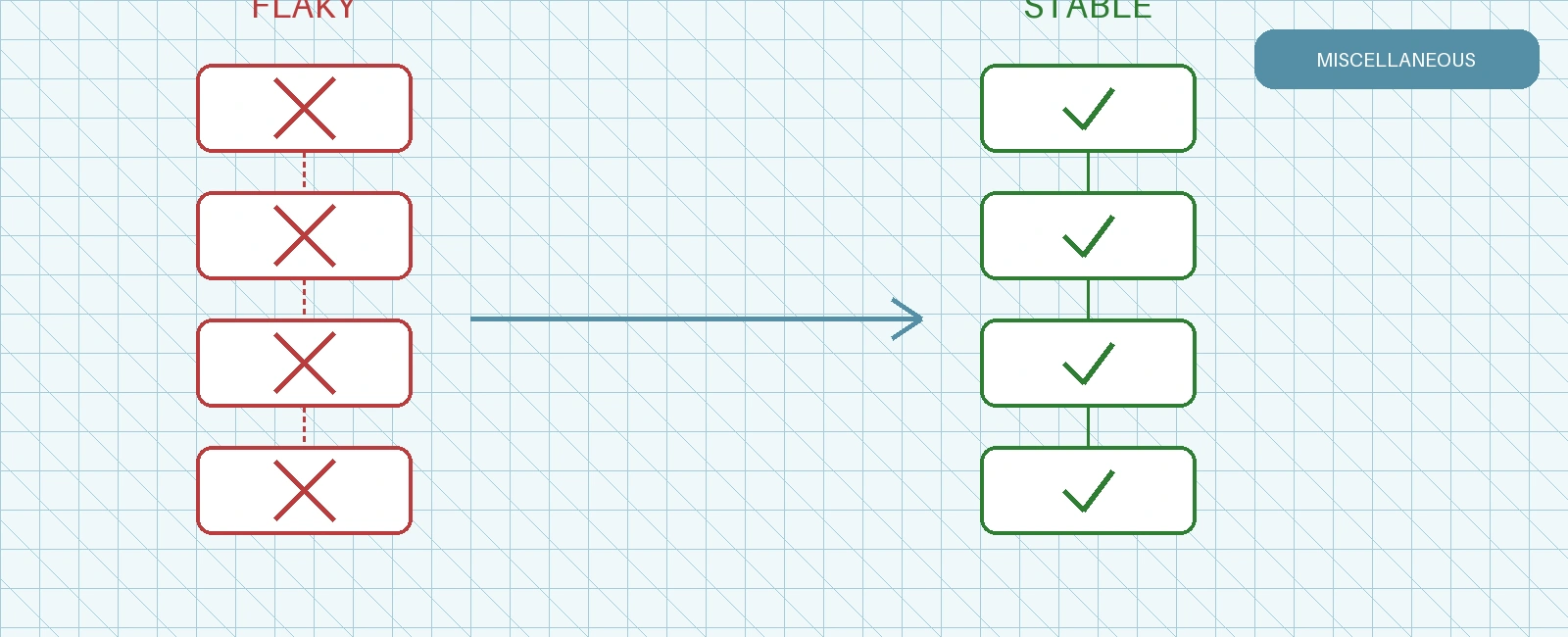
Flaky CI in embedded firmware is not inevitable — it is a design smell. The stabilization path:
The goal is not zero flakiness — it is flakiness that is detected, tracked, and resolved within a bounded timebox. A flaky test that is quarantined, owned, and fixed in two weeks is a healthy signal. A flaky test that blocks merges for months is a process failure.
Teams that adopt this systematic approach typically see:
| Metric | Before | After |
|---|---|---|
| Flaky test rate (stable suite) | 8–15% | <2% |
| Merge block time due to flakiness | 2–4 hours/day | <15 min/day |
| MTTR for flaky tests | Weeks (often never) | 3–14 days |
| CI compute wasted on retries | 30–50% | <5% |
| Developer trust in CI | Low | High |
The investment pays for itself within the first month: reduced CI costs, faster merges, and engineers who stop ignoring test failures. Start with the taxonomy — classify your top 10 flaky tests this week. Build the dashboard next week. Quarantine the worst offenders immediately. The compounding returns on CI reliability are real and measurable.
Quick Links
Legal Stuff